
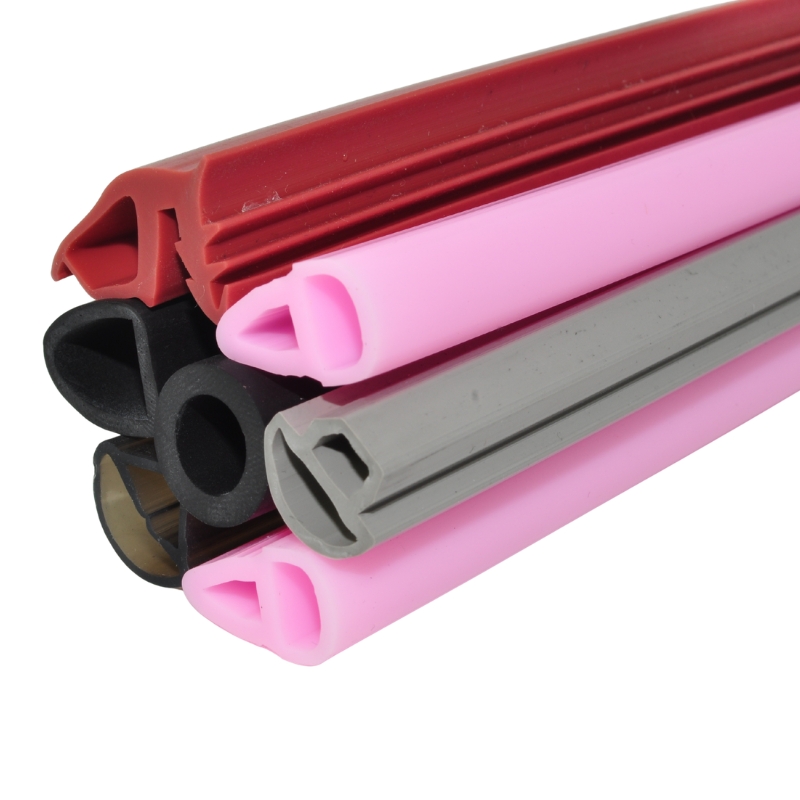
VMQ Silicone Edge Trim Seal
Every high-end appliance needs a clean edge — one that protects exposed sheet metal while absorbing the vibrations and thermal shifts of daily use. This silicone edge trim seal delivers both: a precision-extruded U-channel or D-profile that clips securely onto cabinet flanges, oven panel edges, and refrigerator door rims without adhesive. Available in solid or…
Specifications
|
Product Type: |
Extruded Trim Seal (U-Channel / D-Profile)
|
|---|---|
|
Base Polymer: |
VMQ (Vinyl Methyl Silicone Rubber)
|
|
Structure: |
Solid or Closed-Cell Foam; Co-extruded solid + foam composite available
|
|
Color: |
Translucent white (standard); Custom colors available (RAL, Pantone match)
|
|
Surface Finish: |
Smooth / Matte / Lightly textured per spec
|
|
Standards & Compliance: |
|
|
Hardness: |
Solid: 50 ± 5 Shore A (standard); Range 30–80 Shore A customizable. Foam: 15–35 Shore A equivalent
|
|
Tensile Strength: |
Solid: ≥ 7.0 MPa; Foam: ≥ 1.5 MPa
|
|
Elongation at Break: |
Solid: ≥ 300%; Foam: ≥ 150%
|
|
Tear Strength: |
Solid: ≥ 20 kN/m; Foam: ≥ 8 kN/m
|
|
Recommended Service Temperature: |
–60°C to +200°C (intermittent to +230°C)
|
|
Hot Air Aging: |
200°C × 72h: Hardness change ≤ ±5 Shore A; tensile retention ≥ 80%
|
|
Low‑Temperature Brittleness: |
≤ –60°C
|
|
Typical Applications: |
Oven panel trim, dishwasher door edge seal, refrigerator cabinet flange gasket, washer/dryer lid edge guard, range hood panel edging
|
Description:
Most organic rubbers begin to harden and crack at the temperatures that ovens and dishwashers generate during normal operation. VMQ silicone doesn’t. Its polymer backbone is built on alternating silicon and oxygen atoms — a chain that absorbs neither UV photons nor thermal energy the way carbon-based rubbers do. That molecular stability is why a silicone edge trim stays soft at 200°C and still bounces back after years clamped onto a panel flange at sub-zero storage temperatures.
For appliance OEMs, this translates into a single material that handles the heat zone behind an oven door, the humid interior of a dishwasher, and the cold environment of a refrigerator — without the degradation, staining, or odor issues that plague EPDM or TPE alternatives in the same roles.
Typical Industry Applications:
Proven performance across demanding manufacturing environments.
| Industry | Typical Use Cases |
|---|---|
| Home Appliances | Oven panel edge trim, dishwasher door flange seal, refrigerator cabinet edge gasket, washer/dryer lid edge guard, microwave frame trim |
| Commercial Kitchen Equipment | Industrial oven panel edging, steam cabinet door trim, commercial refrigeration unit flange seal |
| HVAC & Ventilation | Sheet metal duct edge protection, air handling unit panel trim |
| Electronics & Electrical Enclosures | Control panel edge seal, switchboard cabinet flange trim, instrument housing edge guard |
| Lighting & LED | LED fixture housing edge protection, luminaire panel trim, diffuser frame seal |
| Construction & Architecture | Aluminum curtain wall panel edge trim, glass partition frame edging, decorative panel trim |
Chemical Resistance Table:
| Chemical / Medium | Resistance | Notes (optional) |
|---|---|---|
| Water (hot/cold) | ✅ Excellent | No swelling or degradation to 100°C |
| Steam (low pressure) | ✅ Excellent | Stable under repeated dishwasher-cycle steam exposure |
| Dilute acids (acetic, citric) | ✅ Excellent | Suitable for food-adjacent contact |
| Dilute alkalis (NaOH ≤10%) | ✅ Excellent | Withstands common kitchen cleaners |
| UV / Ozone | ✅ Excellent | No cracking or yellowing over extended outdoor exposure |
| Silicone oils & greases | ✅ Excellent | Negligible swell |
| Ethanol / Isopropanol | ✓ Good | Minor swell; full recovery on drying |
| Mineral oils | ⚠ Limited | Moderate swelling (15–30%) over prolonged immersion |
| Petroleum fuels (gasoline, diesel) | ✗ Not recommended | Significant swelling and strength loss |
| Aromatic solvents (toluene, xylene) | ✗ Not recommended | Severe swell; avoid contact |
| Ketones (acetone, MEK) | ⚠ Limited | Noticeable swell; short-term exposure only |
| Concentrated acids (H₂SO₄, HNO₃) | ✗ Not recommended | Chemical degradation of siloxane backbone |
| Hydrogen peroxide (≤3%) | ✓ Good | Acceptable for sanitation wipe-down |
| Ammonia-based cleaners | ✓ Good | Standard household concentrations acceptable |
In-House Quality Assurance & Testing:
At Micune Rubber, batch-to-batch consistency is guaranteed through our ISO-9001 certified Quality Management System. Every rubber compound and custom extrusion undergoes rigorous evaluation in our dedicated testing laboratory before shipment. We utilise industry-standard baseline testing, including Mooney Viscometers to measure compound viscosity and Torque Rheometers to verify exact vulcanisation characteristics. This ensures every material formulation strictly adheres to your required specifications and processing parameters.
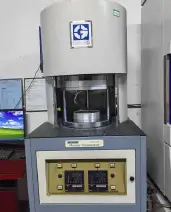
Mooney Viscometer
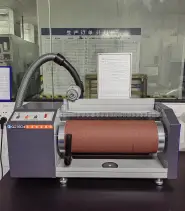
Abrasive Testing Machine
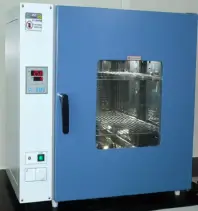
Burn-in Chamber
