
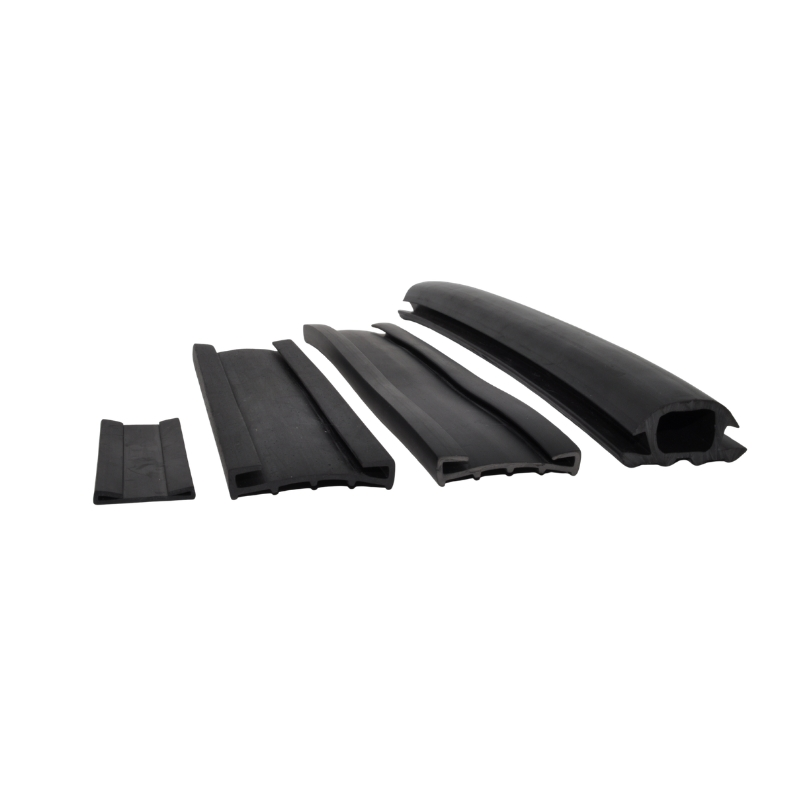
EPDM Anti-Seismic Window & Door Sealing Profile
Designed for aluminum window frames, curtain walls, and door perimeters in seismic-risk zones, this extruded EPDM rubber sealing strip accommodates interstory lateral drift without losing its weatherproof seal — a performance threshold that standard static-compression weatherstrips simply cannot meet. The profile geometry features flexible dynamic lips and hollow-chamber sections engineered to absorb multi-directional displacement while…
Specifications
|
Product Type: |
Extruded EPDM Sealing Profile — Anti-Seismic Series
|
|---|---|
|
Base Polymer: |
Ethylene Propylene Diene Monomer (EPDM)
|
|
Structure: |
Solid / Composite (solid dynamic lip + hollow-chamber body) / Co-extruded solid-foamed
|
|
Color: |
Black (standard); gray, brown, or custom RAL on request
|
|
Surface Finish: |
Smooth matte
|
|
Standards & Compliance: |
|
|
Hardness: |
55 ± 5 Shore A (solid lip); 30–45 Shore A (foamed chamber, composite grades)
|
|
Tensile Strength: |
≥ 10 MPa
|
|
Elongation at Break: |
≥ 350%
|
|
Tear Strength: |
≥ 28 kN/m
|
|
Recommended Service Temperature: |
-45°C to +120°C
|
|
Hot Air Aging: |
70°C × 72h: hardness change ≤ ±8 Shore A; tensile change ≤ ±15%
|
|
Low‑Temperature Brittleness: |
No crack at -45°C
|
|
Typical Applications: |
Aluminum window frame channels, curtain wall glazing gaskets, door perimeter seals, sliding door track seals, unitized facade panel joints
|
Description:
Most window and door sealing strips on the market are designed around a single loading mode: static axial compression. They close a gap. When a seismic event induces interstory drift — the lateral racking of one floor relative to another — the frame doesn’t simply compress the gasket; it shears it. In gasket-glazed curtain wall systems, experimental research has recorded interstory lateral displacements exceeding 100 mm during moderate seismic events, with failure mechanisms including gasket degradation, air/water infiltration breakdowns, and loss of glass retention. A standard closed-cell foam strip or rigid co-extruded PVC weatherstrip has neither the elastic recovery range nor the cross-sectional geometry to absorb that kind of multi-directional movement and spring back intact. The result: post-earthquake facade leakage, thermal bridging, and in severe cases, glazing instability.
Typical Industry Applications:
Proven performance across demanding manufacturing environments.
| Industry | Typical Use Cases |
|---|---|
| Construction & Architecture | Aluminum sliding window seals, casement window perimeter gaskets, curtain wall glazing gaskets, door frame perimeter seals, unitized facade panel joints, seismic-joint covers |
| Automotive & Motorcycle | Door frame perimeter seals, window channel run channels, body-panel gap seals in production vehicles (non-seismic; leverages same compound grade) |
| Home Appliances | Refrigerator door gasket profiles, washing machine door seals, HVAC cabinet perimeter seals |
| Electronics & Industrial Machinery | Enclosure cabinet door seals, outdoor electrical panel weatherstrips, dust-exclusion perimeter profiles |
Chemical Resistance Table:
| Chemical / Medium | Resistance | Notes |
|---|---|---|
| Water / Rainwater | ✅ Excellent | No swelling or degradation; ideal for permanent outdoor exposure |
| Ozone (outdoor atmosphere) | ✅ Excellent | Saturated backbone offers no reactive sites for ozone attack |
| UV / Sunlight | ✅ Excellent | Carbon black UV stabilization standard in all grades |
| Steam | ✅ Excellent | Suitable for steam-cleaned facade surfaces and HVAC environments |
| Dilute acids (pH > 3) | ✓ Good | Suitable for acid rain exposure; concentrated acid contact not recommended |
| Dilute alkalis (pH < 12) | ✓ Good | Compatible with alkaline cleaning agents used in facade maintenance |
| Salt solutions / seawater | ✅ Excellent | Excellent choice for coastal and marine-atmosphere buildings |
| Ethanol / Isopropanol | ✓ Good | Suitable for cleaning product residues; no prolonged immersion |
| Silicone sealants / silicone oils | ✅ Excellent | Chemically compatible; no swelling in contact with silicone structural glazing compounds |
| Water-based hydraulic fluids | ✅ Excellent | No degradation in contact with water-based fire-suppression system fluids |
| Aliphatic hydrocarbons (mineral oil, gasoline) | ✗ Not recommended | EPDM swells significantly in petroleum-based oils; use NBR or FKM for such contact |
| Aromatic hydrocarbons (toluene, xylene) | ✗ Not recommended | Solvent extraction risk; avoid contact with aromatic solvent-based cleaners |
| Ketones (acetone, MEK) | ⚠ Limited | Short-term incidental contact acceptable; no prolonged exposure |
| Concentrated acids (H₂SO₄, HNO₃) | ✗ Not recommended | Surface degradation at high concentrations |
In-House Quality Assurance & Testing:
At Micune Rubber, batch-to-batch consistency is guaranteed through our ISO-9001 certified Quality Management System. Every rubber compound and custom extrusion undergoes rigorous evaluation in our dedicated testing laboratory before shipment. We utilise industry-standard baseline testing, including Mooney Viscometers to measure compound viscosity and Torque Rheometers to verify exact vulcanisation characteristics. This ensures every material formulation strictly adheres to your required specifications and processing parameters.
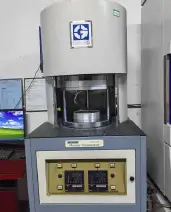
Mooney Viscometer
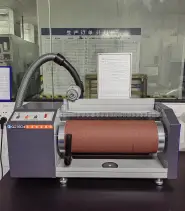
Abrasive Testing Machine
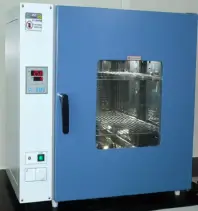
Burn-in Chamber
