
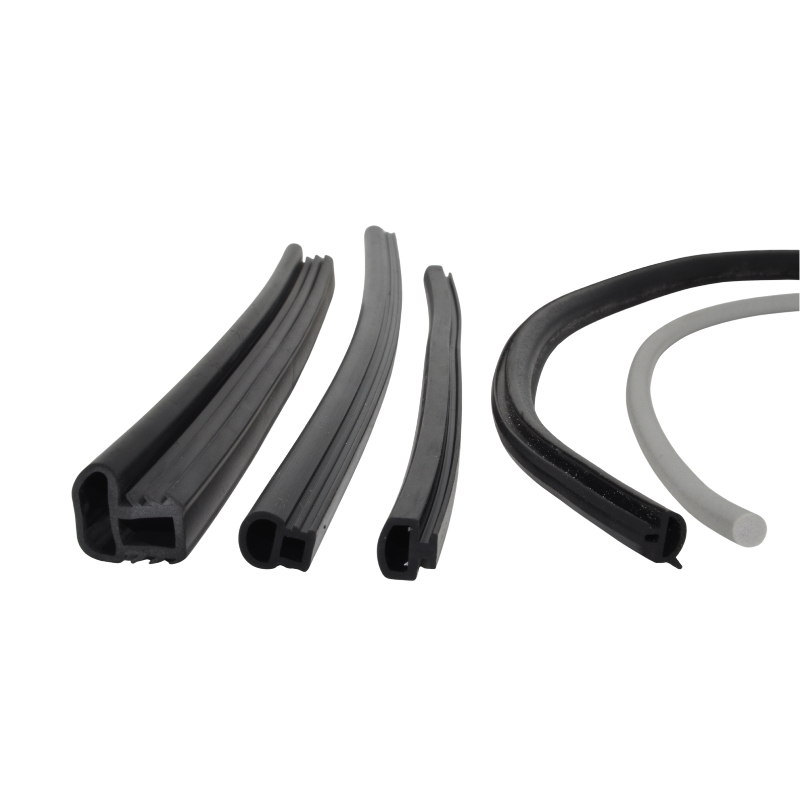
EPDM/VMQ Composite Glazing Channel Seal
Engineered for structural glazing and seismic-rated façade systems, this co-extruded bi-material channel seal pairs an EPDM structural body with a vulcanized VMQ silicone contact lip — two polymers, one profile, each doing what the other cannot. The EPDM body delivers the compressive load capacity, ozone resistance, and dimensional stability demanded by curtain wall framing standards,…
Specifications
|
Product Type: |
Co-extruded composite glazing channel seal / window bead gasket
|
|---|---|
|
Base Polymer: |
Ethylene Propylene Diene Monomer (EPDM) body + Vinyl Methyl Silicone (VMQ) contact lip
|
|
Structure: |
Co-extruded composite (dual-material, single-pass extrusion)
|
|
Color: |
Standard: Black (EPDM body) / Grey or Black (VMQ lip); custom colors available
|
|
Surface Finish: |
EPDM body: matte textured; VMQ lip: smooth, low-friction glass contact surface
|
|
Standards & Compliance: |
|
|
Hardness: |
(EPDM body): 65 ± 5 Shore A, (VMQ lip): 45 ± 5 Shore A
|
|
Tensile Strength: |
(EPDM): ≥ 10 MPa, (VMQ lip): ≥ 6 MPa
|
|
Elongation at Break: |
≥ 280%
|
|
Tear Strength: |
≥ 25 kN/m
|
|
Recommended Service Temperature: |
−45°C to +120°C (EPDM body); VMQ lip rated to +180°C continuous
|
|
Hot Air Aging: |
100°C × 72 h: hardness change ≤ ±8 Shore A; tensile retention ≥ 80%
|
|
Low‑Temperature Brittleness: |
≤ −45°C (EPDM body per GB/T 15256)
|
|
Typical Applications: |
Curtain wall glazing channel, structural glazing bead, seismic-rated window frame seal, fire-rated glass channel retainer, unitized façade panel gasket
|
Description:
A glazing channel seal sounds straightforward until you list what it must do simultaneously: maintain constant glass-face contact pressure after ten thousand thermal cycles, resist UV and ozone at the façade surface for 20+ years, absorb the racking deflection of a seismic event without losing its grip on the glass edge, and do none of these things while leaking air or water. No single elastomer solves all four problems equally well.
EPDM — ethylene propylene diene monomer — owns the structural side of that list. Its fully saturated backbone has no reactive double bonds available for ozone attack, which is why it outlasts neoprene and SBR in exposed façade environments by a factor of three or more. Compressive stiffness in the 60–70 Shore A range gives the channel body enough load capacity to retain glass panels under dead load, wind pressure, and the lateral drift imposed by seismic events. The polymer’s inherent flexibility down to −45°C means the profile remains functional through cold-climate winters without becoming brittle and cracking at the frame corners.
VMQ silicone, by contrast, is the right material for one critical interface: glass contact. Its exceptionally low compression set — ≤ 15% at 70°C — means the lip spring-back force remains nearly constant whether the seal was installed last week or five years ago. EPDM compression set in the same position would allow the sealing lip to “take a set,” reducing contact stress and opening a path for water infiltration. The VMQ lip also presents an inherently smooth, low-friction surface that protects glass edge coatings during thermal expansion movement. Used as the full profile material, however, silicone’s lower modulus and higher cost make it poorly suited for the structural body function.
Typical Industry Applications:
Proven performance across demanding manufacturing environments.
| Industry | Typical Use Cases |
|---|---|
| Construction & Architecture | Curtain wall glazing channel, structural glazing bead, unitized façade panel gasket, spider-glass point-fixed glazing perimeter seal |
| Seismic & Fire-Rated Glazing | Seismic-rated window bead, fire-rated glass channel retainer (intumescent-insert compatible profiles), blast-resistant glazing perimeter seal |
| Automotive & Transportation Infrastructure | Station canopy glazing, bus shelter structural glass retention, high-speed rail window channel |
| Industrial & Commercial Buildings | Skylight perimeter gasket, roof-light glazing seal, structural glass floor panel channel |
| Home Appliances & Electronics | Tempered glass panel retention in oven doors, display case glass channel seals requiring low-compression-set lip contact |
Chemical Resistance Table:
| Chemical / Medium | Resistance | Notes |
|---|---|---|
| Rainwater / Freshwater | ✅ Excellent | Core function; no swelling or degradation over 20+ yr service life |
| Ozone (outdoor UV/O₃ exposure) | ✅ Excellent | Saturated EPDM backbone; no cracking at 50 pphm, 72 h |
| UV radiation | ✅ Excellent | Carbon black-loaded EPDM body; VMQ lip inherently UV-stable |
| Steam / Humidity (condensation) | ✅ Excellent | Both EPDM and VMQ maintain properties in high-humidity environments |
| Dilute alkalis (cleaning agents, concrete alkalinity) | ✅ Excellent | Suitable for contact with alkaline façade wash-down solutions |
| Dilute acids (acid rain, pH 4–6) | ✓ Good | No significant degradation at ambient concentrations |
| Alcohols (isopropanol, cleaning solvents) | ✓ Good | Short-term contact acceptable; not for continuous immersion |
| Glycol-based sealant primers | ✓ Good | Check specific primer compatibility before structural bonding |
| Silicone structural sealants | ✅ Excellent | VMQ lip chemically compatible; no plasticizer migration into silicone sealant |
| Petroleum-based oils / greases | ⚠ Limited | EPDM shows moderate swelling; avoid sustained oil contact on body |
| Aromatic solvents (toluene, xylene) | ✗ Not recommended | Significant swelling of EPDM compound; select NBR or FKM for oil-wet environments |
| Halogenated solvents (MEK, acetone) | ✗ Not recommended | Not compatible with EPDM or VMQ in sustained contact |
| Hydraulic fluid (mineral oil base) | ⚠ Limited | Acceptable for incidental splash only; not for sealing hydraulic circuits |
| Concrete / cementitious mortar (cured) | ✅ Excellent | No reaction; used as perimeter channel sill contact in construction |
In-House Quality Assurance & Testing:
At Micune Rubber, batch-to-batch consistency is guaranteed through our ISO-9001 certified Quality Management System. Every rubber compound and custom extrusion undergoes rigorous evaluation in our dedicated testing laboratory before shipment. We utilise industry-standard baseline testing, including Mooney Viscometers to measure compound viscosity and Torque Rheometers to verify exact vulcanisation characteristics. This ensures every material formulation strictly adheres to your required specifications and processing parameters.
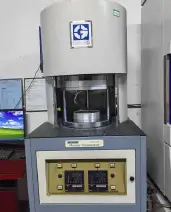
Mooney Viscometer
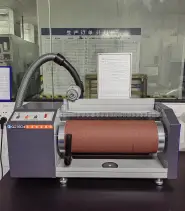
Abrasive Testing Machine
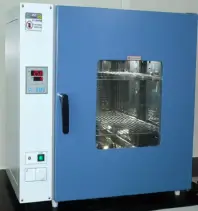
Burn-in Chamber
