
Construction & Building Sealing
Rubber Compounds Engineered for Construction Sealing and Weatherproofing
Building envelopes are subjected to decades of UV radiation, ozone attack, thermal cycling from –30 °C to +80 °C, wind-driven rain, and sustained compression. Every rubber seal in a curtain wall, window frame, or expansion joint must resist permanent compression set while maintaining elastic recovery — because a seal that takes set within the first two years will leak for the next twenty.
General-purpose rubber does not survive long-term outdoor exposure. Weatherproof building seals require compound-specific design — careful selection of polymer backbone, antioxidant systems, filler reinforcement, and vulcanization chemistry — to deliver reliable sealing performance over a building’s service life.
EPDM building seals
Curtain wall gaskets
Weatherstrips & sponge profiles
Outdoor durability
RoHS & PAHs support
Request Construction Compound Samples
Why Rubber Compound Selection Defines Building Seal Life
In construction, rubber sealing is not about short-term performance. A window weatherstrip or curtain wall gasket may need to function for 20 to 30 years without replacement, enduring seasonal temperature extremes, constant UV and ozone exposure, and continuous mechanical compression from frame movement and wind loading.
EPDM (ethylene propylene diene monomer) dominates exterior building seal applications because its saturated polymer backbone delivers inherent resistance to ozone cracking, UV degradation, and moisture absorption. An EPDM compound formulated with ENB-type diene at ≥5 wt% provides effective peroxide cure sites, enabling excellent compression set resistance — critical for seals that remain compressed for years in frame grooves and glazing channels.
However, EPDM is not the only material in play. CR (chloroprene) compounds are selected where flame-retardant characteristics are needed alongside moderate weathering resistance, such as in fire-rated partition seals. Silicone compounds extend the service temperature range to +200 °C and beyond, serving high-temperature flue seals and certain curtain wall applications where thermal bridging is a concern. EPDM sponge profiles — closed-cell or open-cell — provide compressible sealing for variable-gap conditions in expansion joints and door perimeter frames.
Seal cross-section geometry and compression behavior are as important as compound selection. A seal designed for 25% compression in a 10 mm gap requires different durometer and compound rheology than a seal closing a 3 mm glazing channel. Getting compound and geometry right together is what separates a long-lasting building seal from a premature failure point.
Key Applications in Construction & Building
Window & Door Weatherstrips
Perimeter seals for residential and commercial window and door systems, operating under sustained compression in frame grooves exposed to direct sunlight, rain, and temperature cycling from sub-zero to above +60 °C surface temperatures. The seal must maintain elastic recovery after years of continuous compression to prevent air and water infiltration.
Typical material: EPDM solid compound, 55–70 Shore A
UV & ozone resistantCurtain Wall Glazing Gaskets
Precision sealing profiles for unitized and stick-system curtain wall façades. These gaskets seat glass panels against aluminum mullions while accommodating thermal expansion differentials and wind deflection. Compression recovery and dimensional stability over decades of service are non-negotiable performance requirements.
Typical material: EPDM solid, 60–70 Shore A; silicone for high-temperature façade zones
Compression set resistanceExpansion Joint Sealing Profiles
Structural expansion joints in concrete frames, bridge decks, and parking structures require sealing profiles that accommodate movement of ±25% or more while preventing water ingress. The rubber must resist ozone, prolonged water immersion, and repeated cyclic deformation without cracking at fold lines.
Typical material: EPDM sponge or EPDM/CR solid, depending on movement range
Cyclic deformation resistanceWaterproof Seals & Waterstop Profiles
Below-grade construction, retaining walls, and wet-area envelope details use rubber profiles to block water migration through joints. These seals face constant hydrostatic pressure and may be embedded in concrete or mechanically clamped, requiring excellent water resistance and long-term dimensional stability.
Typical material: EPDM or CR solid compound, selected per chemical exposure
Water resistancePipe, Cable & Duct Entry Seals
Penetration seals for building services — HVAC ducts, electrical conduit, and plumbing risers — must maintain air- and water-tight closure around irregular cross-sections. These seals compress against pipes or cables while resisting temperature differentials between conditioned and unconditioned spaces.
Typical material: EPDM solid or EPDM sponge, depending on gap tolerance
Environmental sealingAcoustic & Anti-Vibration Strips
Impact sound isolation in floating floor assemblies, equipment isolation pads, and partition head seals rely on rubber strips that provide controlled damping while maintaining long-term resilience. Low-frequency vibration transmission through building structure requires compounds with appropriate dynamic stiffness and loss factor.
Typical material: EPDM sponge or CR solid, 40–60 Shore A
Vibration dampingMaterial Platforms for Construction Sealing
Selecting the correct elastomer system is the first engineering decision in any building seal project. Each material platform carries specific performance advantages and trade-offs that directly affect seal life, installation behavior, and long-term maintenance cost.
| Material | Best Application Fit | Key Performance | Selection Trade-offs |
|---|---|---|---|
| EPDM | Window weatherstrips, curtain wall gaskets, expansion joint seals, outdoor perimeter sealing | Outstanding UV, ozone, and weathering resistance. Service temperature –40 °C to +120 °C. Excellent compression set resistance when peroxide-cured. Low water absorption. Tensile strength ≥10 MPa achievable with reinforcing filler systems. | Limited oil and hydrocarbon resistance. Not suitable where contact with petroleum-based sealants or fuels is expected. Higher compound cost than SBR or NR for non-weather-critical applications. |
| CR (Neoprene) | Fire-rated partition seals, moderate-weathering exterior profiles, waterproof membrane strips | Self-extinguishing flame behavior. Moderate ozone and UV resistance. Good adhesion to metal substrates. Balanced oil and weather resistance. | Inferior long-term UV and ozone resistance compared to EPDM for exposed exterior applications. Stiffer at low temperatures (brittleness onset around –30 °C depending on grade). Higher density than EPDM. |
| Silicone | High-temperature flue seals, curtain wall thermal-break gaskets, specialty architectural seals requiring extreme temperature range | Widest service temperature range: –60 °C to +200 °C (some grades to +250 °C). Excellent compression set at elevated temperatures. Inherently UV and ozone resistant. Low toxicity and low smoke emission. | Lower tensile strength and tear resistance compared to EPDM. Higher material cost. Limited resistance to concentrated alkaline solutions. Requires careful compound selection for outdoor abrasion exposure. |
| EPDM Sponge / Foam | Variable-gap door and window seals, expansion joint fillers, acoustic isolation strips, soft-closure perimeter sealing | Low compression force allows sealing of irregular or changing gaps. Closed-cell variants provide water exclusion. Light weight reduces installed load on frames. Retains EPDM’s weather resistance characteristics. | Lower recovery force limits use in high-pressure sealing. Not suitable for high-compression structural seals. Density and cell structure must be specified carefully to balance softness against long-term set. |
Featured Products for Construction Applications
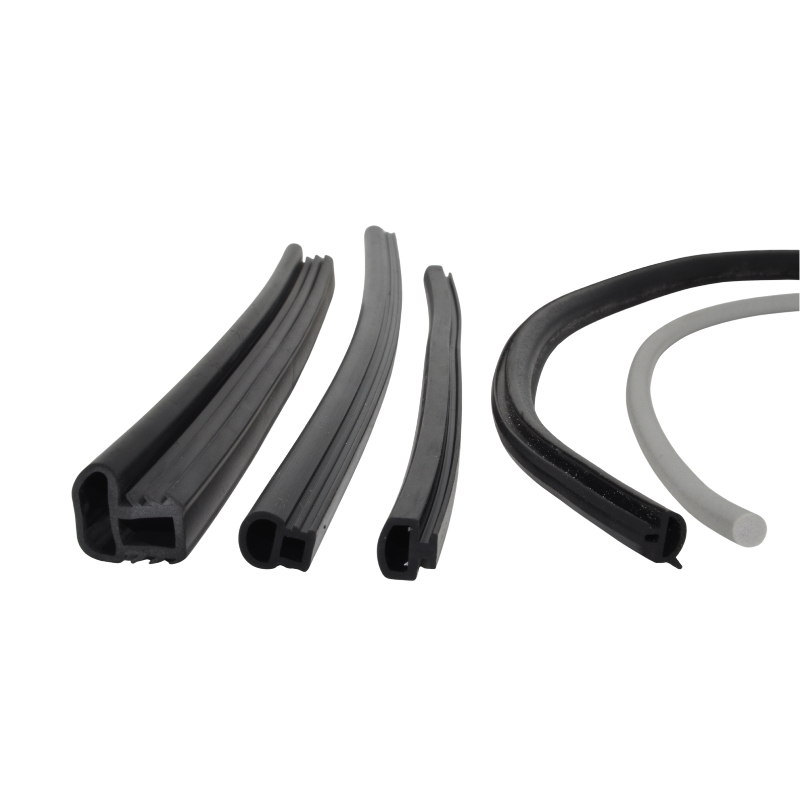
EPDM Window & Door Weatherstrip
Extruded EPDM sealing profile designed for long-term weather exposure in building openings. Formulated for UV and ozone resistance with low compression set under sustained frame compression.
Best for: windows, doors, and perimeter weather sealing
View Product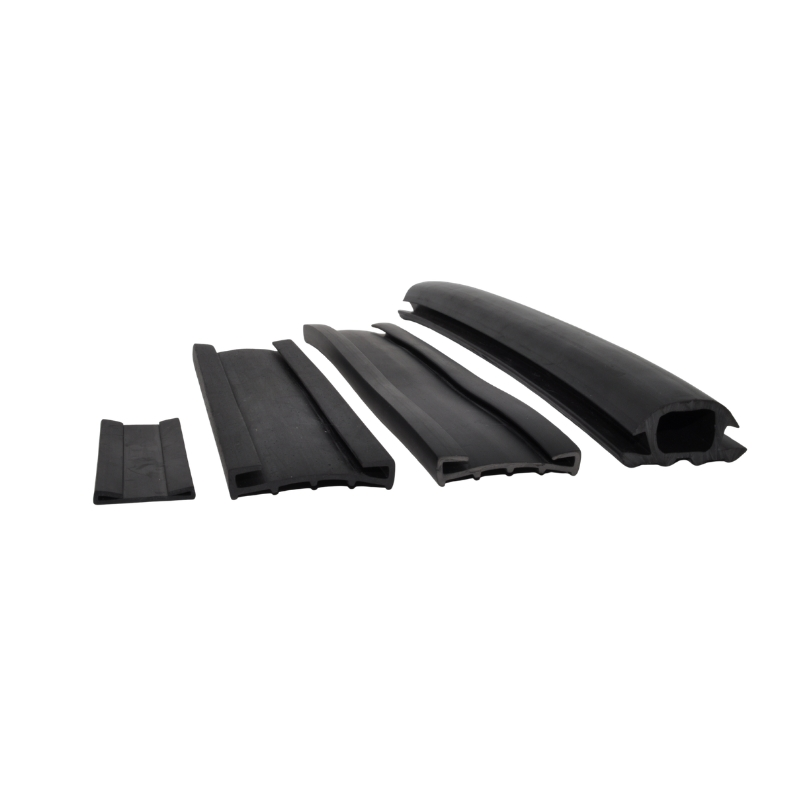
Curtain Wall Rubber Gasket
Precision sealing profile for glazing systems requiring compression recovery and weather durability. Engineered for dimensional stability across thermal cycling in façade assemblies.
Best for: façade systems and glazing interfaces
View ProductValidation for Building and Outdoor End Uses
Construction-grade rubber compounds for exterior weathering applications require verifiable material data — not just general claims. Micune’s EPDM compounds for building sealing are supported by independent laboratory testing and in-house characterization relevant to outdoor seal performance.
- EPDM compound tested for EU RoHS compliance per Directive (EU) 2015/863 — SGS Report No. CANEC26004724721, all 10 regulated substances reported as ND (Not Detected), conclusion: Pass
- PAHs testing per AfPS GS 2019:01 — SGS Report No. CANEC26004724739, all 15 PAH substances and naphthalene reported as ND for the tested EPDM sample
- Low restricted-substance content supports formal materials declarations for projects requiring environmental or health compliance documentation
- In-house testing includes Mooney viscosity (process consistency), MDR rheometer curves (cure characterization), tensile strength and elongation at break, low-temperature brittleness testing, and specific gravity verification
- Project-specific validation supported — datasheets, batch test reports, and compound adjustment to meet specified compression set, hardness, or weathering requirements available on request
Discuss Your Construction Sealing Requirements
Share your section drawings, gap dimensions, exposure conditions, and performance targets. Micune’s compound engineering team works directly with architects, façade system suppliers, weatherstrip extruders, and importers to match material selection to real-world building seal performance requirements.
Get in TouchStart Your Custom Project Today!
Looking to optimise your supply chain? Our engineering team can support your needs for custom rubber compounding, moulded parts, or extrusions. Please submit your requirements below to receive a prompt, factory-direct quote and technical consultation.