
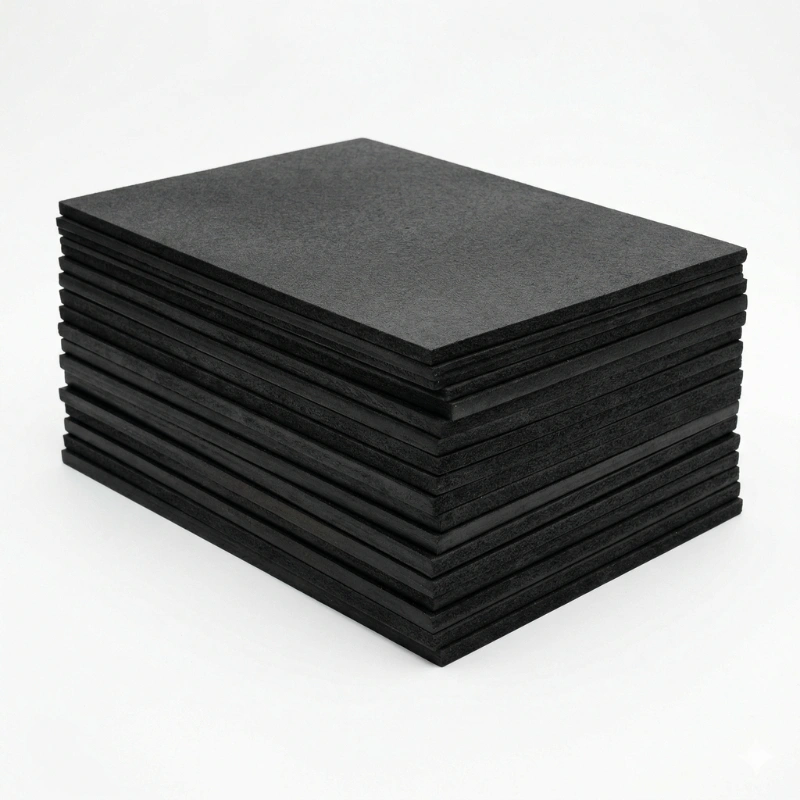
Natural Rubber Compound (NR)
Few elastomers match natural rubber’s combination of raw tensile strength, rebound resilience, and dynamic fatigue resistance — and that’s precisely why it remains irreplaceable in anti-vibration mounts, suspension bushings, and high-load industrial components. Micune’s NR compound grades are precision-formulated from high-grade natural polyisoprene, compounded under ISO 9001-controlled conditions to deliver consistent Mooney viscosity, predictable cure…
Specifications
|
Product Type: |
Rubber Compound (raw / semi-finished)
|
|---|---|
|
Base Polymer: |
NR (Natural Rubber / cis-1,4-Polyisoprene)
|
|
Structure: |
Solid (standard); foamed grades available on request
|
|
Color: |
Black (standard); light-colored
|
|
Surface Finish: |
Smooth (extruded); matte or bonded finishes for molded anti-vibration parts
|
|
Standards & Compliance: |
|
|
Hardness: |
40–70 Shore A (standard range); ±5 Shore A per grade
|
|
Tensile Strength: |
≥ 18 MPa
|
|
Elongation at Break: |
≥ 450%
|
|
Tear Strength: |
≥ 35 kN/m
|
|
Recommended Service Temperature: |
-50°C to +80°C (general grades); up to +100°C with antioxidant-enhanced system
|
|
Hot Air Aging: |
70°C × 72h: Hardness change ≤ ±8 Shore A; Tensile retention ≥ 80%
|
|
Low‑Temperature Brittleness: |
≤ -50°C
|
|
Typical Applications: |
Anti-vibration mounts, engine suspension bushings, bridge bearing pads, conveyor belt covers, heavy equipment shock absorbers
|
Description:
There’s a reason engineers keep coming back to NR when dynamic loading is on the table. Natural rubber — chemically cis-1,4-polyisoprene — has a highly regular molecular structure that enables a level of elastic recovery no synthetic elastomer has fully replicated. Rebound resilience above 70% is typical for well-formulated NR compounds. That means energy is returned to the system rather than dissipated as heat, which matters enormously in applications like anti-vibration mounts and damping bushings that cycle millions of times over a product’s life.
Tensile strength routinely exceeds 25 MPa in gum (unfilled) NR — higher than NBR, EPDM, or CR at equivalent hardness. The tear resistance follows suit. These aren’t just laboratory numbers; they translate directly into thinner wall sections, longer service intervals, and lower warranty costs for your assembled parts.
That said, NR has real weaknesses. It’s an unsaturated polymer — the carbon-carbon double bonds in the backbone are reactive sites for ozone attack, UV degradation, and oxidative aging. Resistance to petroleum oils and fuels is poor compared to NBR. These limitations are real, and they’re why raw NR block isn’t the same as a properly engineered NR compound.
Typical Industry Applications:
Proven performance across demanding manufacturing environments.
| Industry | Typical Use Cases |
|---|---|
| Automotive & Motorcycle | Engine mounts, transmission bushings, subframe isolators, bump stops, anti-vibration washers, brake pad shims |
| Industrial Machinery | Machine feet and leveling pads, conveyor belt covers and skirt seal compounds, pump housing dampers |
| Construction & Infrastructure | Bridge bearing pads, expansion joint filler strips, pile cap cushions, rail fastening pads |
| Electronics & Consumer Appliances | Vibration isolation grommets, cable conduit grommets, appliance foot pads |
| Agricultural & Heavy Equipment | Cab isolation mounts, implement hose inner compounds, shock absorber bump stops |
Chemical Resistance Table:
| Chemical / Medium | Resistance | Notes |
|---|---|---|
| Water (fresh, distilled) | ✅ Excellent | Minimal swell; suitable for water-contact applications |
| Dilute acids (sulfuric, hydrochloric < 10%) | ✓ Good | Adequate for intermittent exposure |
| Dilute alkalis (NaOH, KOH < 20%) | ✓ Good | General industrial use acceptable |
| Ethanol / isopropanol | ✓ Good | Limited swell at ambient temperatures |
| Ketones (acetone, MEK) | ⚠ Limited | Notable swell; short-term contact only |
| Aromatic hydrocarbons (toluene, xylene) | ✗ Not recommended | Severe swelling and strength loss |
| Aliphatic hydrocarbons (mineral spirits, gasoline) | ✗ Not recommended | Significant volumetric swell |
| Petroleum oils / mineral hydraulic fluids | ✗ Not recommended | Oil resistance is NR’s primary limitation; use NBR for oil environments |
| Ozone (dynamic / static) | ⚠ Limited | Antidegradant package provides partial protection; avoid prolonged outdoor exposure |
| UV / sunlight | ⚠ Limited | Carbon black grades offer better UV stability than light-colored compounds |
| Air aging (≤ 80°C) | ✓ Good | Antioxidant-enhanced grades suitable for continuous service |
| Steam (< 100°C) | ⚠ Limited | Short-duration only; hydrolysis risk at extended exposures |
| Phosphate ester fluids | ✗ Not recommended | Incompatible; causes rapid compound degradation |
In-House Quality Assurance & Testing:
At Micune Rubber, batch-to-batch consistency is guaranteed through our ISO-9001 certified Quality Management System. Every rubber compound and custom extrusion undergoes rigorous evaluation in our dedicated testing laboratory before shipment. We utilise industry-standard baseline testing, including Mooney Viscometers to measure compound viscosity and Torque Rheometers to verify exact vulcanisation characteristics. This ensures every material formulation strictly adheres to your required specifications and processing parameters.
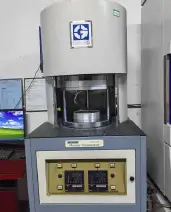
Mooney Viscometer
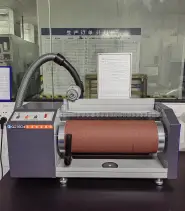
Abrasive Testing Machine
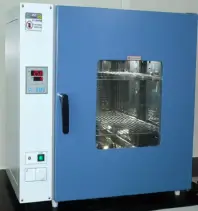
Burn-in Chamber
