
Baby Care & Mother Care — Silicone Compound Solutions
Food-Grade Silicone Compounds for Baby Care and Mother Care Products
Products in direct or indirect contact with infants and mothers demand a material standard that general-purpose silicone simply cannot meet. Low volatile matter, controlled overall migration, documented sensory performance, and traceable compliance data are non-negotiable for products entering regulated markets. Micune supplies application-qualified silicone compounds — not generic raw material — formulated specifically for baby-contact and mother-contact applications.
Silicone compound selection for baby products requires matching Shore A hardness, cure system, pigment system, and post-cure protocol to the specific product function. A breast pump valve requires different recovery and fatigue behaviour than a bottle nipple. A food-grade silicone straw compound must pass volatile matter limits under GB 4806.16-2025 Appendix B conditions. The compound behind the product determines whether it passes or fails — not the moulding process alone.
Food-contact silicone
GB 4806.16-2025 support
Low volatile matter
Baby product applications
Custom silicone compounds
Request Compound Datasheet or Sample
Why Material Control Matters Here
Baby Care and Mother Care Products Require a Different Level of Material Qualification
Infant and maternal products are subject to the strictest end-use environment in consumer goods: prolonged skin contact, repeated oral contact, thermal cycling through sterilisation, and regulatory scrutiny across multiple markets simultaneously. A compound specification that satisfies an industrial seal application is categorically insufficient here.
The four material control requirements that matter most in this product category are: low volatile matter (residual low-molecular-weight siloxanes that can transfer to food or breast milk during sterilisation or storage), migration control (the total mass of extractable substances released under food-simulant conditions), sensory performance (absence of foreign odour or taste that would affect product acceptance), and non-toxic pigment systems (heavy metal content in coloured compounds held below regulatory thresholds).
The difference between a general silicone compound and an application-qualified food-contact silicone compound is not a marketing distinction — it is a measurable, test-reportable difference. Volatile matter in a standard platinum-cured silicone compound without post-cure can exceed 1.0 g/100g. The GB 4806.16-2025 limit is 0.5 g/100g. Compliance starts at the compounding stage: the base polymer selection, filler loading, and post-cure protocol must be engineered together to bring the final compound below the threshold with margin to spare.
Micune’s silicone compounds for baby and mother care applications are formulated from vapour-phase silica-reinforced silicone polymer systems using platinum cure, with post-cure protocols that measurably reduce volatile content below regulatory limits — not as a post-hoc treatment, but as a built-in formulation outcome.
Application-Specific Guidance
Key Applications in Baby Care & Mother Care
Feeding
Baby Bottle Nipples and Teats
Bottle nipples and teats undergo continuous mechanical deformation during feeding, repeated autoclaving, and prolonged contact with milk at elevated temperatures. The compound must deliver consistent softness in the 30–45 Shore A range with high elongation at break (typically >400%) and excellent compression set recovery to prevent flow-rate drift over the product’s service life.
Platinum-cured food-contact silicone is the standard material here. Peroxide-cured grades are unsuitable for this application because peroxide by-products contribute to volatile contamination and sensory failure. The silicone base polymer should be a high-consistency rubber (HCR) system reinforced with fumed silica, without aromatic processing aids.
Drinkware
Food-Grade Silicone Straws
Silicone straws for baby and toddler drinking cups are among the highest-scrutiny applications in this category: thin wall sections, flexible geometry, repeated bending, and direct oral contact under a wide range of beverage temperatures. The compound must pass volatile matter limits under post-cure conditions and show no sensory deterioration of the immersion solution during migration testing.
Micune’s food-grade silicone straw compound has been independently tested under GB 4806.16-2025 (CTI Report A226016477010100101), returning volatile matter of 0.24 g/100g against a limit of 0.5 g/100g, and overall migration reported as not detected. Compounds are available in translucent and pigmented variants for product differentiation without compromising compliance.
Oral Contact
Pacifiers and Soothers
Pacifiers involve sustained oral contact with saliva at body temperature over extended durations — one of the most demanding migration test scenarios in baby product compliance. A compound intended for this application must demonstrate very low extractable content under acidic and water-based simulants and absolutely no detectable odour or taste transfer.
Platinum-cured silicone in the 25–40 Shore A range is standard, with particular attention to the absence of residual catalyst by-products and the control of oligomeric siloxane content. The soft tactile character of low-durometer silicone is essential for infant acceptance, but it must not come at the cost of elevated extractables.
Mother Care
Breast Pump Valves and Membranes
Duck-bill valves, diaphragm membranes, and flange inserts in breast pump assemblies operate under cyclic stress from repeated vacuum-driven deformation — potentially hundreds of cycles per use session and thousands over the product’s service life. The compound must maintain dimensional stability and elastic recovery without creep, and must not transfer extractables to expressed milk at body temperature.
A medium Shore A silicone (40–55 Shore A) with high tear strength and very low compression set is the target formulation profile. The silicone must retain its mechanical properties and food-contact compliance through repeated steam sterilisation and boiling-water disinfection cycles, which places demands on crosslink network stability as well as the volatile content baseline.
Developmental
Teething Toys and Training Cup Components
Teething and developmental products are placed in the infant’s mouth without controlled duration or temperature parameters. The compound must be formulated without plasticisers, aromatic processing oils, or phthalates, with all pigment systems verified for heavy metal content. Shore A hardness targets typically fall in the 30–50 range to provide the sensory feedback associated with safe teething function.
For training cup spouts and mouthpieces, abrasion and bite resistance supplement the food-contact requirement. Higher silica loading can improve tear and abrasion performance while remaining compatible with food-contact compliance — a formulation balance that requires deliberate compound engineering rather than off-the-shelf material selection.
Accessories
Bottle Seals, Caps, and Soft-Touch Feeding Accessories
Silicone sealing rings, stopper caps, protective sleeves, and soft-grip feeding accessories span a wide range of Shore A requirements — from 30 Shore A for flexible squeeze spouts to 60–70 Shore A for rigid-feel protective caps. Each sub-application carries its own sterilisation exposure and contact conditions that must be matched to the compound specification.
Multi-component feeding systems often require silicone compounds in two or more hardness grades produced as a coordinated specification set, ensuring consistent visual colour, comparable migration performance, and compatible cure schedules across parts assembled in the same product. Micune can supply matched compound sets across hardness ranges from a consistent formulation platform, simplifying incoming quality management for assembly manufacturers.
Compound Selection Guide
Silicone Material Platforms for Baby Care Products
The right silicone compound for a given baby or mother care application depends on four primary variables: cure system, Shore A target, sterilisation method compatibility, and contact conditions. The platforms below map these variables to the compound grades Micune supplies for this category.
Platinum-Cured Silicone
The required cure system for any product in direct oral or food contact. Platinum catalysis produces no organic by-product residues, results in lower extractable content versus peroxide systems, and is fully compatible with post-cure treatment to drive volatile matter below 0.5 g/100g. Best for bottle nipples, pacifiers, teething products, breast pump membranes, and straws. Required for projects targeting GB 4806.16-2025, LFGB Category I, or FDA 21 CFR 177.2600.
Peroxide-Cured Silicone
Suitable for non-food-contact or indirect-contact components in baby and mother care assemblies — protective covers, cable grommets, handle grips, and housing seals where the silicone does not contact food, milk, or oral surfaces. Peroxide-cured grades offer a cost advantage on high-volume, non-contact components, but are excluded from any application where migration testing is required.
Soft Shore A Grades (25–45 Shore A)
Used for tactile, skin-contact, and oral-contact elements: pacifiers, nipple shields, teats, flexible straw bodies, and valve diaphragms. Micune’s soft grades achieve tensile strength above 6 MPa and elongation at break above 400% at 30 Shore A, maintaining structural integrity for thin-walled moulded parts without sacrificing softness or compliance with food-contact volatile limits.
Medium Shore A Grades (50–65 Shore A)
Applied to breast pump flanges, bottle seal rings, structural valve components, and training cup spouts where dimensional stability and recovery under load are primary design criteria. At this hardness range, compounds can be formulated to achieve tensile strength above 9 MPa with compression set below 10% at 70°C/24h — a performance profile that supports repeated steam sterilisation without dimensional creep.
Pigmented Food-Contact Silicone Systems
Colour differentiation is a product design requirement in baby drinkware and feeding accessories. Micune’s pigmented food-contact silicone uses inorganic oxide pigment systems verified against heavy metal limits. Colour performance is matched across batches to support production consistency. All pigmented variants are produced on the same platinum-cure base polymer and post-cure protocol as the corresponding translucent grades, maintaining compliance parity across colour options.
Product Catalogue
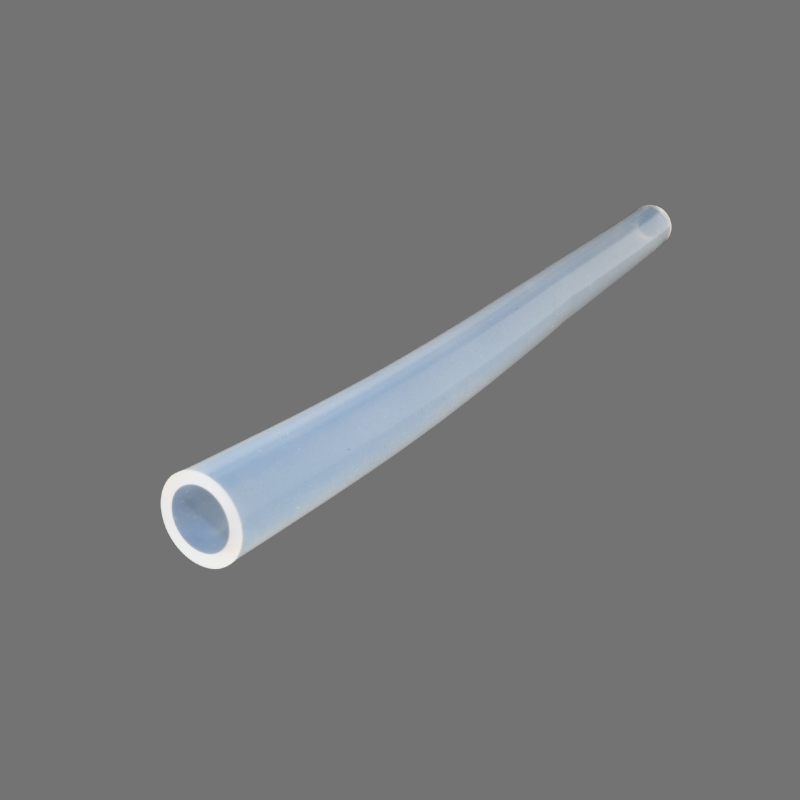
Featured Products for Baby Care Applications
Food-Grade Silicone Straw
Soft, food-contact silicone straw compound designed for repeated use and low volatile content. Formulated on a platinum-cured base system and post-cured to bring volatile matter well below the GB 4806.16-2025 limit of 0.5 g/100g. CTI test-verified at 0.24 g/100g with overall migration not detected under standard food-simulant conditions.
Best for: baby drinking accessories and reusable feeding products
View Product
Third-Party Test Evidence
Testing and Compliance for Baby Contact Applications
Claiming food-grade status is straightforward. Demonstrating it through independent third-party testing is what distinguishes a qualified silicone compound from an unverified one. The data below is drawn from an actual CTI test report on Micune’s white translucent silicone straw compound — not from specification sheets or supplier declarations.
| Test Item | Method Standard | Test Condition | Result | Limit | Status |
|---|---|---|---|---|---|
| Sensory Requirements | GB 4806.16-2025 | Visual assessment + immersion solution | Normal colour and luster; no foreign smell or impurity; immersion solution clear with no colour, turbidity, or odour | Normal appearance; no sensory deterioration of immersion solution | PASS |
| Overall Migration | GB 31604.8-2021 | 10% ethanol simulant; 70°C, 2h; S/V = 6.0 dm²/L | N.D. (<3.0 mg/dm² detection limit) | ≤10 mg/dm² | PASS |
| Potassium Permanganate Wastage | GB 31604.2-2016 | Water simulant; 60°C, 2h; S/V = 6.0 dm²/L | N.D. (<1.0 mg/kg detection limit) | ≤10 mg/kg | PASS |
| Heavy Metal (as Pb) | GB 31604.9-2016 Method 1 | 4% acetic acid; 60°C, 2h; S/V = 6.0 dm²/L | <1 mg/kg | ≤1 mg/kg | PASS |
| Volatile Matter | GB 4806.16-2025 Appendix B | White translucent silicone straw sample | 0.24 g/100g | ≤0.5 g/100g | PASS |
Source: CTI Test Report No. A226016477010100101, issued 16 March 2026. Sample: white translucent silicone straw compound. All test items comply with GB 4806.16-2025. Issued by Centre Testing International Group Co., Ltd., Shenzhen, China.
The volatile matter result of 0.24 g/100g sits 52% below the regulatory ceiling of 0.5 g/100g — a meaningful compliance margin across normal production variation. This is a formulation outcome driven by post-cure protocol design, not a result close to the threshold. For products that undergo repeated steam sterilisation cycles throughout their service life, a compound with this level of volatile headroom will remain within compliance limits more reliably than one formulated near the limit.
For projects targeting LFGB (Germany), FDA 21 CFR 177.2600 (United States), or REACH (EU) market qualification, Micune can discuss compound test scope and food-simulant selection on a case-by-case basis, matched to your product’s contact conditions, temperature, and duration. Please include your target market, sterilisation method, and hardness requirement when making an enquiry.
Discuss Your Silicone Compound Requirement
Whether you are developing a new baby care product, qualifying a replacement compound for an existing production line, or entering a new regulatory market that requires documented food-contact compliance — send us your product type, target hardness, sterilisation method, and target market. We will respond with compound options, available test data, and sample lead time.
Submit a Technical Enquiry