
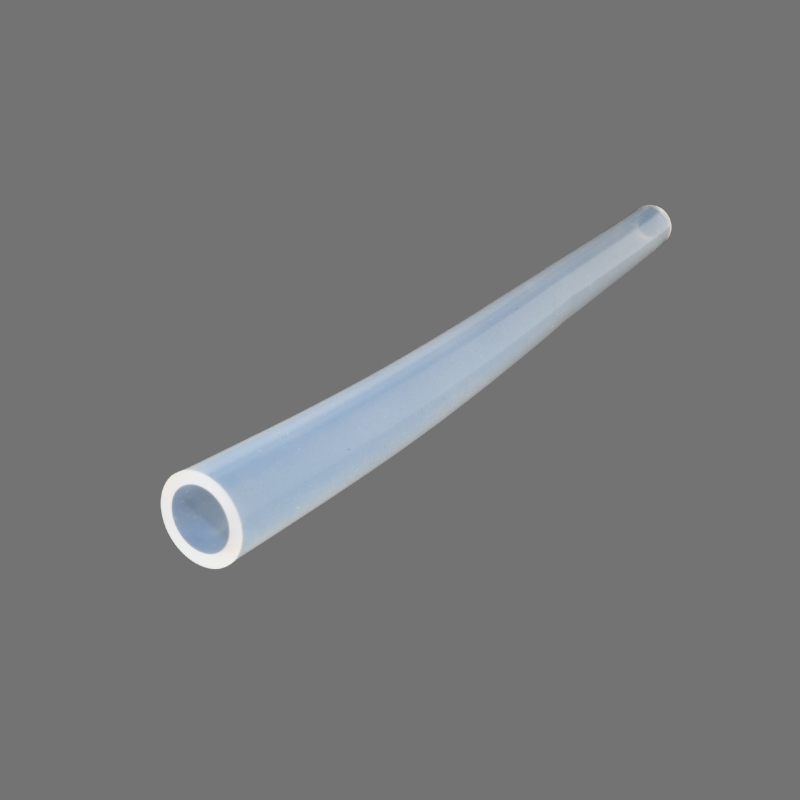
Food-Grade Silicone Tube
Certified under GB 4806.16-2025 by Centre Testing International (CTI Report No. A226016477010100101, March 2026) with all five test categories returning PASS — this platinum-catalyzed, post-cured food grade silicone tube delivers verified low extractables, zero foreign odor, and volatile matter of just 0.24 g/100g against a 0.5 g/100g limit. Engineered for continuous service from -60°C to…
Specifications
|
Product Type: |
Food-contact silicone tube, extruded hollow profile
|
|---|---|
|
Base Polymer: |
Vinyl methyl silicone rubber (VMQ)
|
|
Structure: |
Solid-wall extruded tube; composite or dual-lumen available on request
|
|
Color: |
Transparent / white translucent (standard); custom color per spec
|
|
Surface Finish: |
Smooth, odor-free, non-tacky; matte or glossy selectable
|
|
Standards & Compliance: |
|
|
Hardness: |
40–70 Shore A (standard 50 ± 5 Shore A; customizable)
|
|
Tensile Strength: |
≥ 6.5 MPa
|
|
Elongation at Break: |
≥ 350%
|
|
Tear Strength: |
≥ 18 kN/m
|
|
Recommended Service Temperature: |
-60°C to +200°C continuous; short-term peaks to +230°C
|
|
Hot Air Aging: |
200°C × 4 h: hardness change ≤ ±8 Shore A; tensile retention ≥ 80%
|
|
Low‑Temperature Brittleness: |
≤ -60°C (passes GB/T 15256 brittleness test)
|
|
Typical Applications: |
Baby sippy cup straws, coffee/espresso machine water lines, juice dispenser tubing, pharmaceutical peristaltic pump tubes, food-processing fluid transfer
|
Description:
Before discussing chemistry or process, the compliance record stands on its own. CTI Report No. A226016477010100101 — issued March 16, 2026, by Centre Testing International Group Co., Ltd. — confirms this food grade silicone rubber passes every mandatory category under GB 4806.16-2025: sensory, overall migration, potassium permanganate wastage, heavy metals (as Pb), and volatile matter. The overall migration result came back N.D. (not detected, MDL 3.0 mg/dm²) under 10% ethanol at 70°C for 2 hours — a simulant condition aggressive enough to cover carbonated juices and mild acidic beverages. Heavy metal leaching tested in 4% acetic acid at 60°C returned less than 1 mg/kg against the 1 mg/kg ceiling. Volatile matter measured 0.24 g/100 g — less than half the permitted limit of 0.5 g/100 g. That last number is where secondary vulcanization (二次硫化, post-cure) becomes commercially relevant.
Typical Industry Applications:
Proven performance across demanding manufacturing environments.
| Industry | Typical Use Cases |
|---|---|
| Food & Beverage Equipment | Juice dispenser transfer tubing, espresso machine internal water lines, dairy processing flexible connections, carbonated beverage dosing hoses |
| Baby & Infant Products | Sippy cup straws, bottle valve liners, breast pump suction tubes, infant feeding accessory seals |
| Pharmaceutical & Medical | Peristaltic pump tubing, IV fluid transfer lines (non-implant), laboratory dispensing systems, clean-room flexible conduits |
| Home Appliances | Coffee maker and kettle outlet hoses, water purifier internal tube connections, steam iron flexible feed lines |
| Automotive & Motorcycle | Cabin air freshener dosing lines, coolant overflow breathing tubes (non-pressure; internal aesthetics requiring odor neutrality) |
Chemical Resistance Table:
| Chemical / Medium | Resistance | Notes |
| Water (ambient to 100°C) | ✅ Excellent | Core food-contact medium; negligible swelling |
| Steam (≤ 150°C, intermittent) | ✅ Excellent | Suitable for dishwasher and autoclave sterilization cycles |
| Steam (> 150°C, continuous) | ⚠ Limited | Prolonged high-pressure steam causes gradual hydrolytic degradation of Si–O backbone |
| Dilute acids (citric, acetic, tartaric ≤ 5%) | ✅ Excellent | Passed CTI 4% acetic acid immersion, 60°C × 2 h |
| Dilute alkalis (NaOH ≤ 10%) | ✅ Excellent | Stable for CIP cleaning in food processing |
| Ethanol / isopropanol (≤ 70%) | ✅ Excellent | Passed CTI 10% ethanol migration test |
| Ketones (acetone, MEK) | ✓ Good | Slight temporary swelling; recovers on drying |
| Vegetable oils / animal fats | ✓ Good | Low swelling; suitable for food-oil incidental contact |
| Ozone / UV / atmospheric oxygen | ✅ Excellent | Si–O backbone inherently ozone-resistant; no antiozonant required |
| Concentrated sulfuric acid (> 50%) | ✗ Not recommended | Hydrolyzes siloxane backbone; avoid contact |
| Concentrated alkali (NaOH > 20%) | ✗ Not recommended | Progressive chain scission at elevated temperature |
| Aliphatic hydrocarbons (hexane, mineral spirits) | ⚠ Limited | Moderate swelling; not suitable for continuous immersion |
| Aromatic solvents (toluene, xylene) | ✗ Not recommended | High swelling; significant mechanical property loss |
| Chlorinated solvents (DCM, TCE) | ✗ Not recommended | Severe swelling and extraction of low-MW species |
In-House Quality Assurance & Testing:
At Micune Rubber, batch-to-batch consistency is guaranteed through our ISO-9001 certified Quality Management System. Every rubber compound and custom extrusion undergoes rigorous evaluation in our dedicated testing laboratory before shipment. We utilise industry-standard baseline testing, including Mooney Viscometers to measure compound viscosity and Torque Rheometers to verify exact vulcanisation characteristics. This ensures every material formulation strictly adheres to your required specifications and processing parameters.
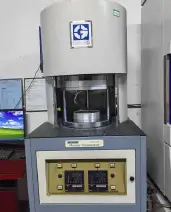
Mooney Viscometer
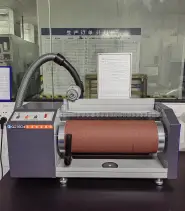
Abrasive Testing Machine
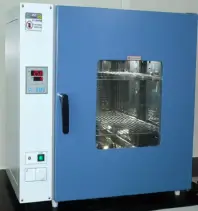
Burn-in Chamber
