
Rubber & Silicone Compounds by Application
Every Industry Has a Different Compound Problem. We Solve It at the Formulation Level.
Automotive seals, food-contact baby products, construction weatherstrips, home appliance gaskets, and LED lighting profiles each impose a distinct set of material constraints. Micune develops application-specific rubber and silicone compounds for each of these markets—formulated from the performance target backwards, not adapted from stock grades.
Select your industry below to explore material options, performance requirements, and available certification documentation. Or contact the Micune technical team directly with your application specifications.
Material Engineering by Market
Why One Compound Cannot Serve Every Application
The difference between an EPDM automotive door seal and an EPDM construction weatherstrip is not just geometry. The automotive compound must cure completely in a short press cycle, maintain flexibility at −40°C, and survive UV and ozone exposure without cracking at sustained temperatures up to +130°C. The construction compound prioritises long-term compression set resistance over a 20-year outdoor service life, requiring a different cure system, different plasticiser loading, and a different accelerator package entirely.
In baby care, the polymer family shifts to food-grade silicone, and the performance criteria shift to GB 4806.16-2025 overall migration limits, volatile matter thresholds, and the secondary vulcanisation cycle time required to meet them. In LED lighting, the same silicone base must be compounded for optical transmission above 90% and dimensional stability under sustained module heat—variables determined entirely by filler type, loading, and dispersion quality in the mixed compound.
For NBR in automotive fuel system seals, acrylonitrile (ACN) content is the critical formulation variable: an 18% ACN grade maximises low-temperature flexibility; a 33% ACN grade balances fuel swell resistance with −25°C cold performance for pump seals and grommets; a 41% ACN grade provides maximum hydrocarbon resistance for direct fuel contact at the cost of cold flexibility. These are not interchangeable grades—they are distinct design decisions. Micune makes them at the formulation stage, before the compound reaches your production line.
Five Industry Verticals
Industry Applications We Serve
EPDM Weather Seals, NBR Fuel System Compounds, and Under-the-Hood Parts
Automotive body seals, window run channels, coolant hoses, and under-the-hood grommets each demand formulations validated to ASTM D2000 and ISO 3302. EPDM solid and sponge compounds for exterior sealing must achieve tensile strength above 10 MPa and elongation exceeding 300% while retaining low-temperature flexibility to −40°C. Peroxide cure systems are preferred for EPDM grades with ENB diene content above 5%, enabling complete network formation at automotive press cycle times.
Fuel and oil-contact applications use NBR with ACN content selected to match the service environment. Fuel line grommets and low-pressure pump seals typically specify 33% ACN for the balance of swell resistance and cold flexibility. High-temperature oil seal compounds may use ACM or HNBR where NBR reaches its thermal limits. CR grades provide ozone resistance for underbonnet hose couplings operating near exhaust heat.
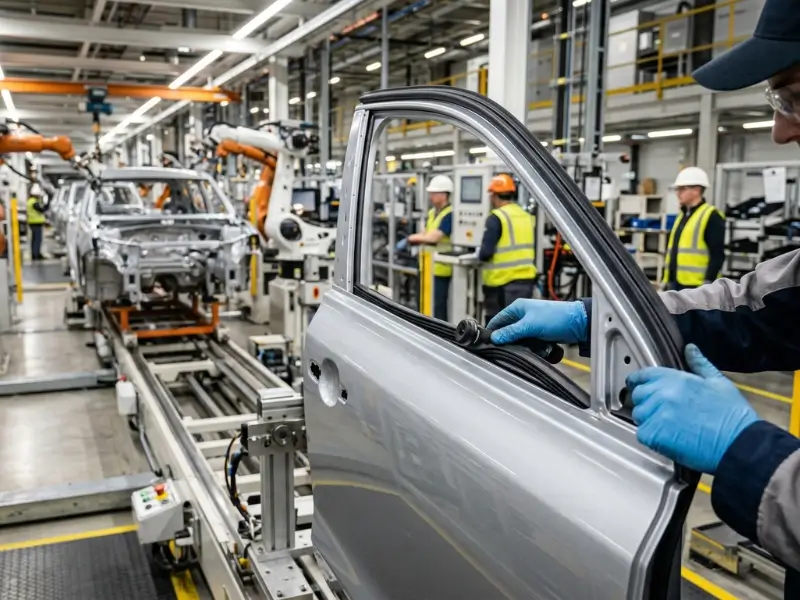
EPDM door seals • NBR fuel grommets • HNBR hoses
Food-Grade Silicone Compounds for Infant and Feeding Products
Silicone straws, drinking cup components, and breast pump parts that contact infants operate under the strictest compound performance requirements of any market Micune serves. GB 4806.16-2025 governs overall migration limits, specific restricted substance thresholds, and volatile matter content for food-contact silicone in China, and meeting those thresholds requires both the correct base polymer system and a controlled post-cure process.
Micune’s food-contact silicone compounds use high-transparency fumed-silica-reinforced polymer, processed through a secondary vulcanisation cycle at 200°C for a minimum of four hours. This drives residual unreacted crosslinker and low-molecular-weight silicone oligomers below the volatile matter limits in GB 4806.16-2025. SGS-tested certification documentation is available for customer regulatory submissions and retail compliance programmes in China and export markets.
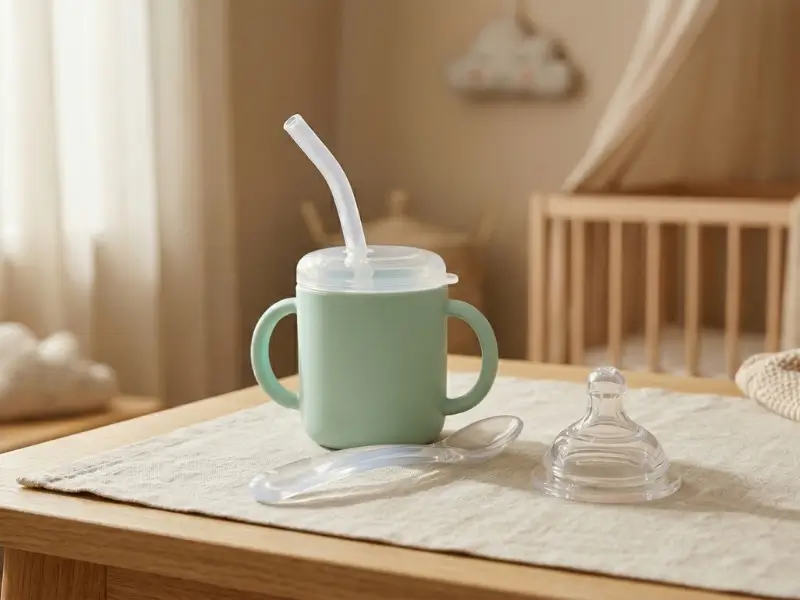
Silicone straws • Cup components • Breast pump parts
Weatherstrip, Facade Seal, and Anti-Vibration Compounds for the Built Environment
Curtain wall glazing seals, door and window weatherstripping, expansion joint profiles, and structural anti-vibration mounts share a common primary failure mode: irreversible compression set under sustained static load, combined with surface degradation from atmospheric ozone and UV radiation. Construction compounds are specified around long-term compression set resistance as the primary performance criterion, with UV and ozone resistance as mandatory secondary requirements across a 20+ year expected service life.
EPDM provides inherent UV and ozone resistance without surface protection additives, making it the default polymer for outdoor building seals in solid and foam profiles. Silicone compounds are specified where temperature excursions exceed the practical range of EPDM or where transparency is needed for aesthetic glazing applications. TPE profiles meeting European standard glazing gasket dimensions are available for projects requiring a specific durometer range or improved recyclability at end of service life.

Facade seals • Weatherstrip • Anti-vibration mounts
High-Tolerance Gaskets, Hoses, and Damping Compounds for Appliance OEMs
Washing machine door gaskets, dishwasher seals, steam hoses, and vibration-damping mounts for appliances are precision components in automated assembly lines. Hardness drift of ±5 Shore A between compound batches translates directly to fitment rejects and line stoppages. Mooney viscosity consistency run-to-run determines whether the compound flows and fills a complex mould profile the same way on the 50,000th cycle as on the first.
Silicone solid and foam compounds manage high-temperature steam applications in dishwashers and steam-cleaning appliances. EPDM compound hoses handle coolant and process water routing where sustained pressure and temperature resistance to 130°C are required. Dual-colour silicone extrusion is available for steam spray hoses where separate flow channels require visual identification. All appliance-targeted compounds are available with RoHS compliance documentation (SGS tested, EU Directive 2015/863).
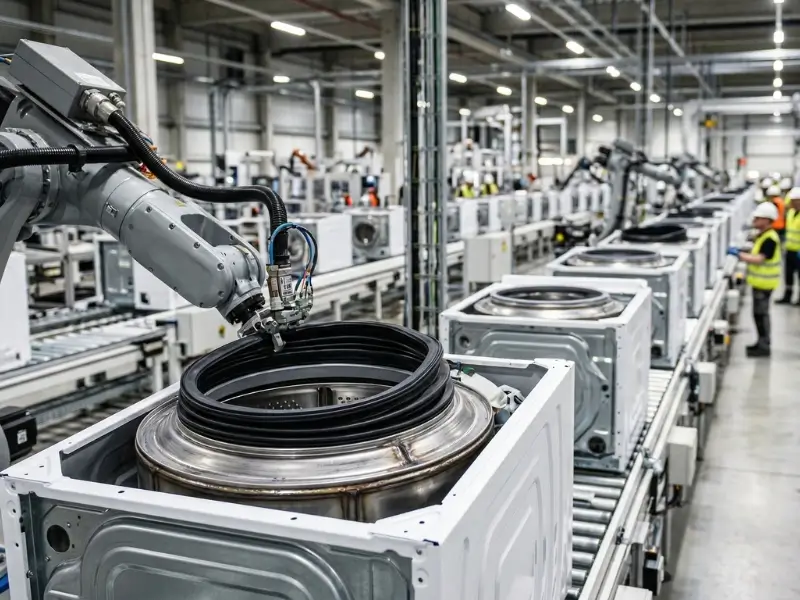
Door gaskets • Steam hoses • Vibration dampers
Transparent and Translucent Silicone Compounds for LED Strip Profiles and Fixtures
LED strip silicone sleeves, end caps, and protective covers are performance components in the optical path of a lighting fixture. They must maintain light transmission above 90%, fit consistently onto aluminium extrusion profiles through automated sleeving, and withstand sustained surface temperatures generated by high-power LED modules without yellowing or hardness drift over the fixture’s rated service life.
Each of these requirements is determined at the compound formulation stage, not at the extrusion die. Reinforcing filler type and loading define both final Shore A hardness and the ceiling on optical transmission. Filler dispersion uniformity in the mixed compound governs transmission consistency along the sleeve length; poor dispersion creates visible hot spots and transmission variation that cannot be corrected downstream. Micune holds Shore A hardness to ±3 degrees batch-to-batch on LED silicone compounds, supporting high-volume automated profile sleeving without manual selection.
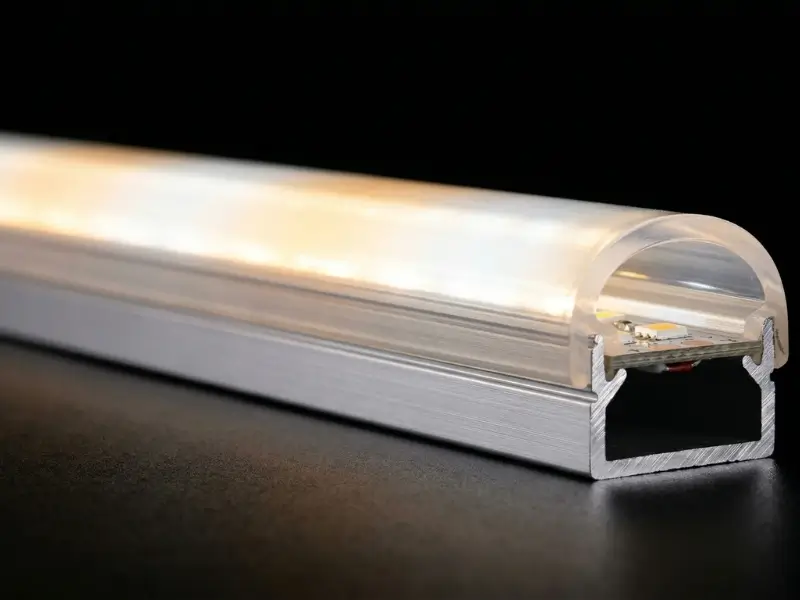
Silicone sleeves • End caps • IP-rated covers
Compound Formulation & QC
Cross-Industry Rubber Compounding Capabilities
Micune’s compound portfolio covers NR, SBR, NBR, CR, EPDM, FPM (Viton), IIR (Butyl), ACM, HNBR, TPE, and silicone systems—all formulated and mixed in-house. This multi-polymer breadth allows OEM procurement teams to consolidate rubber compound supply across multiple product lines under a single supplier with consistent formulation records, shared certification infrastructure, and unified batch traceability.
Compound characterisation is performed in-house using a Mooney Viscometer for processability verification, a Moving Die Rheometer (MDR-2000E) for full cure kinetics including T10, T90, and MH−ML torque delta, a tensile testing machine, a DIN Abrasion Tester, a Low-Temperature Brittleness Tester, and a Specific Gravity Tester. Engineers and procurement managers may request full material release data and MDR cure curves for each production batch. ISO 9001:2015 process documentation provides the batch traceability framework that makes these records auditable for supplier qualification.
Engagement Model
How Micune Works with OEMs, ODMs, and Distributors
Micune’s role in a customer’s supply chain is as the compound development and supply partner upstream of their moulding, extrusion, or fabrication operation. The starting point is always the application specification: target Shore A hardness, service temperature range, chemical media exposure, dimensional tolerance, and the regulatory standards that govern the finished product’s end market. These inputs determine the polymer system, cure chemistry, and filler strategy before any material is mixed.
Micune can develop compounds to match an existing material code from a current supplier, or formulate from first principles against a published standard such as ASTM D2000, GB 4806.16-2025, RoHS Directive EU 2015/863, or AfPS GS 2019:01 for PAHs. Importers and distributors sourcing rubber compounds for their own customers benefit from Micune’s stable, documented supply model: consistent Mooney viscosity batch-to-batch, predictable cure windows, and certification documentation current for their target retail or regulatory market.
Trial compounds are submitted with full characterisation data for customer evaluation. Once a formulation is approved, production transfers to the same documented parameters under ISO 9001:2015 process controls. Batch records are retained and available on request throughout the supply relationship.
Requirements & Specification
Define hardness target, temperature range, chemical media, tolerances, and applicable compliance standards. Micune recommends polymer system and cure chemistry based on application inputs—not catalogue defaults.
Formulation, Trials & Validation
Trial compounds are mixed, characterised (Mooney, MDR, tensile, hardness), and submitted with complete test data. Iterative adjustment continues until all specification parameters are confirmed. Pre-production samples are provided for your internal validation and supplier qualification process.
Series Production & Supply
Approved formulations transfer to production under ISO 9001:2015 process controls with full batch traceability. Mooney viscosity and MDR cure data available on request per batch. Production capacity supports volume ramp-up without reformulation or process change.
Get in Touch
Discuss Your Next Rubber or Silicone Application
Whether you are developing a new automotive seal program, qualifying a food-contact silicone for a baby product launch, or sourcing EPDM weatherstrip material for a construction project, Micune’s technical team can specify the correct compound, confirm available certification documentation, and arrange material samples for your evaluation.
Send us your application industry, service environment, target Shore A hardness, required certifications, and approximate annual volume. We will respond with a compound recommendation and available test data within one business day.
Talk to a Rubber Compounding Expert