
Lighting & LED Industry
Silicone & EPDM Rubber Sealing Compounds for LED and Lighting Applications
LED fixtures and lighting assemblies demand seals that withstand sustained operating temperatures of 80–200 °C, direct UV exposure, outdoor weathering cycles, and the moisture-ingress requirements defined by IP54 through IP68 enclosure ratings. Whether the application is a recessed downlight, an outdoor floodlight housing, or a marine-rated underwater luminaire, the sealing compound determines how long the fixture maintains its optical clarity, electrical safety, and enclosure integrity.
Silicone compounds are selected when fixture junction temperatures exceed 150 °C or when long-term flexibility across a –60 °C to +200 °C service window is non-negotiable. EPDM compounds serve outdoor and general-purpose lighting seals where UV and ozone resistance matter most, and continuous temperatures remain below 120 °C. The correct choice depends on IP target, housing material compatibility, and the thermal profile of the LED driver and array.
Silicone lighting gaskets
EPDM outdoor seals
IP-rated sealing support
UV and heat resistance
Export compliance support
Request a Lighting Seal Quote
Why Sealing Material Selection Defines LED Fixture Reliability
In every LED and lighting system — from residential panel lights to industrial high-bay fixtures — the seal between the housing and the lens or diffuser is the primary barrier against moisture, particulates, and corrosive gases. A failed gasket does not simply let in water; it accelerates LED phosphor degradation, corrodes solder joints on the PCB, and introduces condensation that scatters or blocks light output. The consequences are premature lumen depreciation, driver failure, and warranty returns.
Three environmental factors drive material selection for lighting seals. First, heat: LED junction temperatures in enclosed fixtures routinely reach 100–150 °C, and driver housings can exceed this range in poorly ventilated designs. Sealing compounds must retain compression set resistance at these temperatures without hardening or cracking. Second, UV exposure: outdoor fixtures and any luminaire with a clear lens transmit significant UV radiation to the gasket surface, demanding materials with inherent UV stability rather than reliance on surface antioxidants alone. Third, IP rating requirements: achieving IP65 or IP67 ratings requires consistent gasket compression across thermal cycles, meaning the compound must maintain its Shore A hardness and elastic recovery over years of service from –40 °C winter nights to +60 °C summer rooftop conditions.
The correct sealing compound must also be chemically compatible with the enclosure material — whether die-cast aluminium, polycarbonate, or stainless steel — without outgassing volatiles that could fog the optical lens. This is where material-specific formulation, not generic off-the-shelf rubber, makes the difference between a fixture that lasts 50,000 hours and one that fails in the field.
Key Applications in LED & Lighting
LED Panel & Downlight Housing Gaskets
Recessed LED panels and downlights use thin-profile gaskets between the aluminium frame and the diffuser plate. These seals must compress evenly at low closure force to avoid distorting thin-gauge housings. Silicone compounds in the 30–50 Shore A range provide the necessary compliance while resisting the 80–120 °C operating temperatures typical in enclosed ceiling cavities where airflow is restricted.
Silicone — 30–50 Shore ATypical IP requirement: IP40–IP54 for indoor recessed fixtures
Outdoor Floodlight & Streetlight Seals
Outdoor floodlights and streetlights are exposed to continuous UV irradiation, rain, temperature cycling from –30 °C to +55 °C ambient, and ozone concentrations typical of urban environments. EPDM compounds formulated with peroxide cure systems deliver excellent ozone crack resistance and UV stability across a 10–15 year outdoor service life. For fixtures operating at higher internal temperatures, silicone sealing compounds extend the thermal ceiling to 200 °C continuous.
EPDM or Silicone — application dependentTypical IP requirement: IP65–IP66 for outdoor pole-mounted fixtures
Linear Light End-Cap & Channel Seals
LED linear strips mounted in aluminium extrusion channels require end-cap seals and continuous run gaskets that maintain IP protection along the full length of the profile. Silicone compounds are preferred for this application because their low compression set ensures the seal remains functional even as the aluminium profile thermally expands and contracts. Micune produces silicone sleeve and cover plate profiles in cross-sections from 10 × 20 mm to 20 × 20 mm for both side-emitting and D-type emitting channel configurations.
Silicone — extruded profilesTypical IP requirement: IP20 (dry interior) to IP67 (wet-area linear applications)
High-Bay Industrial Fixture Perimeter Seals
Industrial high-bay LED fixtures in factories, warehouses, and food processing plants must seal against dust, moisture, cleaning chemicals, and sustained internal temperatures from high-wattage LED arrays. Perimeter gaskets in 50–60 Shore A silicone provide the heat resistance required for fixtures running at 100–150 W while maintaining the IP65 rating demanded in industrial environments where washdown protocols are standard.
Silicone — 50–60 Shore ATypical IP requirement: IP65–IP66 for industrial and food-processing environments
Marine & Underwater Light Sealing Components
Submersible and marine-rated luminaires face the most demanding sealing conditions in the lighting industry: full water immersion, salt spray corrosion, UV degradation, and hydrostatic pressure at depth. Silicone compounds formulated for IP68 applications maintain their elastic recovery and sealing force under sustained submersion. The material must not leach plasticisers or silicone oils that could cloud the optical window or attract biological fouling.
Silicone — IP68 rated formulationsTypical IP requirement: IP68 — continuous submersion at specified depth and duration
Solar Garden & Exterior Lighting Seals
Solar-powered garden lights, pathway bollards, and decorative exterior luminaires use low-cost enclosures that must survive years of unprotected outdoor exposure. EPDM sealing compounds offer cost-effective weathering resistance for these applications, with proven performance against ozone cracking, UV embrittlement, and freeze-thaw cycling. Where fixture temperatures remain below 100 °C, EPDM provides an economical alternative to silicone without sacrificing outdoor durability.
EPDM — cost-effective outdoor sealingTypical IP requirement: IP44–IP55 for garden and decorative fixtures
Recommended Materials for Lighting Seals
Material selection for LED fixture gaskets is driven by three variables: maximum continuous operating temperature, outdoor exposure duration, and IP rating target. The table below maps each material platform to its performance envelope in lighting applications.
Silicone (VMQ / HTV)
Where it fits: LED panel gaskets, high-bay perimeter seals, underwater luminaire seals, linear light channel profiles, and any fixture where junction or driver temperature exceeds 120 °C.
Temperature suitability: –60 °C to +200 °C continuous; short-term excursions to +230 °C. Maintains flexibility and compression set resistance across this entire window — critical for fixtures that cycle between cold-start and steady-state operating temperatures daily.
UV / ozone behaviour: Inherently resistant to UV degradation and ozone attack due to the siloxane (Si-O-Si) backbone, which does not contain carbon-carbon double bonds susceptible to ozone cleavage. No surface chalking or cracking after prolonged outdoor exposure.
Electrical insulation: Volume resistivity typically >1012 Ω·cm. Silicone gaskets serve a dual function in lighting enclosures — sealing against moisture while also providing dielectric isolation between conductive housing components.
Why preferred for hotter fixtures: When LED driver housings or high-wattage arrays push internal temperatures above 120 °C, EPDM compression set accelerates and seal integrity declines. Silicone retains <25% compression set at 150 °C after 72 hours, making it the default choice for enclosed, high-power fixtures.
EPDM (Ethylene Propylene Diene Monomer)
Where it fits: Outdoor floodlight housings, streetlight lens gaskets, garden and pathway light seals, and general-purpose exterior enclosures operating below 120 °C continuous.
Temperature suitability: –40 °C to +120 °C continuous. Performs well for outdoor fixtures in all climate zones where the fixture’s internal thermal load does not drive gasket temperatures above this ceiling. Low-temperature brittleness resistance to –40 °C without cracking.
UV / ozone behaviour: Excellent resistance due to the saturated polymer backbone. EPDM does not require carbon black loading for UV protection — it can be formulated in lighter colours for applications where gasket visibility or aesthetic integration matters. Ozone crack resistance is inherent to the ethylene-propylene structure.
Electrical insulation: Volume resistivity >1013 Ω·cm in clean formulations. EPDM provides effective dielectric performance for outdoor lighting junction boxes and wiring compartments.
Why selected for outdoor general sealing: For fixtures where the thermal load is modest (≤100 °C) and the primary challenge is weathering, EPDM delivers comparable outdoor longevity to silicone at a lower compound cost — making it the rational material choice for high-volume outdoor lighting programs.
NBR — Limited-Use Comparison
Where it fits: NBR (nitrile rubber) is occasionally encountered in legacy lighting designs or specifications inherited from industrial enclosure standards. However, it is not recommended for lighting seals exposed to UV or ozone.
Temperature suitability: –30 °C to +100 °C. Adequate thermal range, but surpassed by both silicone and EPDM for lighting applications.
UV / ozone behaviour: Poor. The unsaturated carbon-carbon bonds in the NBR backbone are vulnerable to ozone cracking and UV-initiated surface degradation. Outdoor NBR gaskets typically show visible surface cracking within 12–24 months of installation, compromising IP integrity.
Electrical insulation: Moderate. Not preferred where dielectric performance is a design requirement.
Summary: NBR should be replaced with EPDM or silicone in any lighting application involving outdoor exposure, UV transmission through the lens, or ozone-rich environments. Micune can recommend direct drop-in replacements for NBR-based specifications.
Featured Products for Lighting Applications
Compounds and materials engineered for specific lighting environments, available for sampling and technical evaluation.
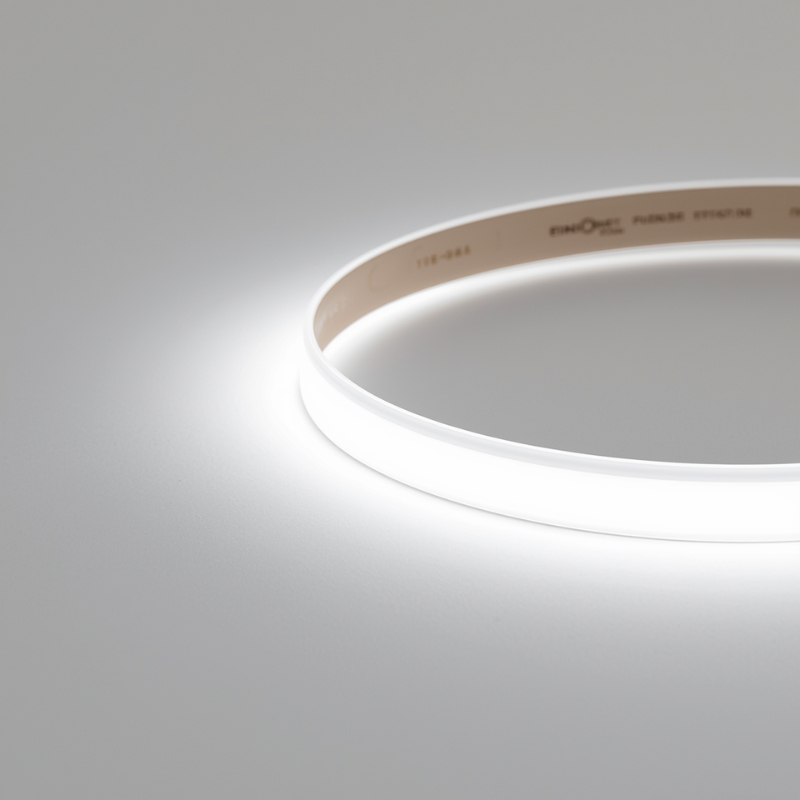
VMQ Silicone LED Strip Cover
Extruded silicone profile engineered as a sleeve and cover for LED strip channel assemblies. Heat-stable across a –60 °C to +200 °C service range with excellent UV and ozone resistance for both indoor and outdoor linear lighting installations. Maintains optical clarity and elastic recovery through repeated thermal cycling.
Best for: LED strip channel sealing and linear fixture profiles
View Product DetailsCompliance and Verification for Lighting Exports
LED and lighting products destined for European, North American, and other regulated markets must comply with the EU RoHS Directive (EU) 2015/863, which restricts lead, mercury, cadmium, hexavalent chromium, PBBs, PBDEs, and four phthalates (DEHP, BBP, DBP, DIBP) in electrical and electronic equipment — including the sealing components within the fixture assembly.
Micune’s EPDM rubber compounds have been tested by SGS under report CANEC26004724721, with all ten restricted RoHS substances reported as ND (Not Detected) for the tested sample. The same EPDM compound was tested for PAHs compliance under SGS report CANEC26004724739, following the AfPS GS 2019:01 standard, with all 15 listed PAHs reported as ND for the tested sample.
For lighting programs that specify silicone sealing compounds, Micune can extend similar third-party testing protocols to silicone-based formulations. Our in-house laboratory supports formulation verification through Mooney viscosity testing, Moving Die Rheometer (MDR-2000E) cure characterisation, tensile strength and elongation testing, and low-temperature brittleness evaluation — ensuring compound behaviour is controlled and repeatable before production-scale mixing on our 26 compounding lines.
If your lighting fixture program requires specific compliance documentation — RoHS declarations, PAHs reports, material safety data sheets, or custom test protocols — our technical team can align testing scope to your export market requirements.
Discuss Your Lighting Seal Requirements
Share your fixture’s IP target, operating temperature range, housing material, and service environment. Micune’s compounding engineers will recommend the right silicone or EPDM formulation — backed by 8,000+ tons/year production capacity, 26 mixing lines, and third-party compliance testing to support your export program.
Contact Micune EngineeringStart Your Custom Project Today!
Looking to optimise your supply chain? Our engineering team can support your needs for custom rubber compounding, moulded parts, or extrusions. Please submit your requirements below to receive a prompt, factory-direct quote and technical consultation.