

Nitrile Rubber Seal (NBR)
Engineered for continuous contact with engine oils, transmission fluids, and hydrocarbon fuels, these nitrile rubber seals are compounded across a defined ACN range of 28–40% — each grade selected to match the chemical aggression and temperature profile of a specific oil-circuit position. Unlike commodity NBR, every compound here starts with an ACN decision: low-mid grades…
Specifications
|
Product Type: |
Automotive oil seal, shaft seal, O-ring, gasket, hose end seal (molded or extruded)
|
|---|---|
|
Base Polymer: |
Nitrile Butadiene Rubber (NBR), ACN content 28–40%
|
|
Structure: |
Solid — compression molded, transfer molded, or continuous extrusion
|
|
Color: |
Black (standard); custom color per customer spec
|
|
Surface Finish: |
Smooth / matte; post-cure flash-trimmed
|
|
Standards & Compliance: |
|
|
Hardness: |
50–80 Shore A (±5); standard automotive grade 60–70 Shore A
|
|
Tensile Strength: |
≥ 10 MPa (medium-ACN grades ≥ 12 MPa)
|
|
Elongation at Break: |
≥ 300%
|
|
Tear Strength: |
≥ 20 kN/m
|
|
Recommended Service Temperature: |
−40°C to +120°C (grade-dependent: 28–33% ACN down to −40°C; 36–40% ACN continuous to +120°C)
|
|
Hot Air Aging: |
100°C × 70 h: hardness change ≤ ±8 Shore A; tensile retention ≥ 80%
|
|
Low‑Temperature Brittleness: |
≤ −40°C (28–33% ACN grades per ASTM D746)
|
|
Typical Applications: |
Engine crankshaft oil seal, transmission shaft seal, fuel filler gasket, hydraulic O-ring, power steering hose seal
|
Description:
NBR’s oil resistance is not a fixed property — it scales directly with acrylonitrile content, and that relationship is what separates a compound engineer’s decision from a catalog search. The polar nitrile groups in the polymer backbone resist swelling when exposed to non-polar hydrocarbons: raise the ACN percentage and you tighten volume swell in ASTM Oil No. 3, synthetic transmission fluid, and aromatic-rich fuels; reduce it and the glass transition temperature drops, keeping the seal pliable at -40°C cold-starts.
For crankshaft and camshaft seals — where continuous mineral oil contact runs at 100–120°C — a 36–40% ACN compound is selected. Transmission shaft seals operating in ATF at moderate temperatures, and fuel filler gaskets requiring low-temperature resilience in northern-climate vehicles, call for a 28–33% ACN grade. Hydraulic O-rings in power steering circuits represent an intermediate case: a 34% ACN compound balances swell control with sufficient cold-bend behavior down to -30°C. The ACN decision happens before a single gram of compound is mixed — not during compound adjustments.
Typical Industry Applications:
Proven performance across demanding manufacturing environments.
| Industry | Typical Use Cases |
|---|---|
| Automotive & Motorcycle | Engine crankshaft oil seals, camshaft seals, transmission shaft seals, hydraulic power steering hose seals, fuel filler neck gaskets, differential seals, O-rings for engine block assemblies |
| Construction & Architecture | Hydraulic cylinder seals for excavator arms and cranes, pneumatic tool seals, compressor gaskets |
| Home Appliances | Pump seals for washing machines, oil-lubricated motor shaft seals, compressor valve gaskets in air conditioners |
| Electronics & Industrial Machinery | Hydraulic manifold O-rings, lubricated gearbox seals, pneumatic actuator lip seals, pump diaphragm gaskets |
Chemical Resistance Table:
| Chemical / Medium | Resistance | Notes |
|---|---|---|
| Mineral engine oil (SAE 5W-30, 10W-40) | ✅ Excellent | Core performance driver; volume swell <15% in IRM 903 at 100°C for 40% ACN grades |
| Automatic transmission fluid (ATF) | ✅ Excellent | Stable across -30°C to +120°C service window |
| Hydraulic fluid — petroleum-based (HM, HV) | ✅ Excellent | Preferred NBR application; minimal compression set increase |
| Diesel fuel | ✅ Excellent | Low aromatic content diesel — strong performance |
| Unleaded gasoline / petrol | ✓ Good | High-aromatic blends require 36–40% ACN grade to control swell |
| Grease (lithium, calcium soap) | ✅ Excellent | Long-term grease contact — no significant degradation |
| Water / steam (≤ 80°C) | ✓ Good | Adequate for intermittent water contact; not designed for continuous steam |
| Ethanol-blended fuel (E10–E20) | ✓ Good | 36–40% ACN preferred; higher ethanol ratios increase polarity-driven extraction |
| Glycol-based coolant | ✓ Good | Compatible; ensure no extended contact above 100°C |
| Aliphatic solvents (hexane, heptane) | ✓ Good | Acceptable for splash contact; continuous immersion requires higher ACN |
| Aromatic solvents (benzene, toluene, xylene) | ⚠ Limited | Swelling increases significantly; FKM recommended for high-aromatic continuous contact |
| Phosphate ester hydraulic fluid (Skydrol-type) | ✗ Not recommended | NBR degrades rapidly; specify EPDM or FKM |
| Ketones (acetone, MEK) | ✗ Not recommended | Polar solvents attack NBR backbone; not compatible |
| Concentrated acids / strong oxidizing agents | ✗ Not recommended | Severe degradation; material selection review required |
| Ozone / UV (unshielded outdoor exposure) | ⚠ Limited | NBR is ozone-sensitive; antidegradant package included but outdoor static service requires CR or EPDM |
In-House Quality Assurance & Testing:
At Micune Rubber, batch-to-batch consistency is guaranteed through our ISO-9001 certified Quality Management System. Every rubber compound and custom extrusion undergoes rigorous evaluation in our dedicated testing laboratory before shipment. We utilise industry-standard baseline testing, including Mooney Viscometers to measure compound viscosity and Torque Rheometers to verify exact vulcanisation characteristics. This ensures every material formulation strictly adheres to your required specifications and processing parameters.
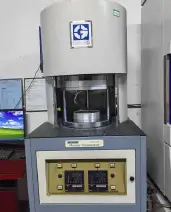
Mooney Viscometer
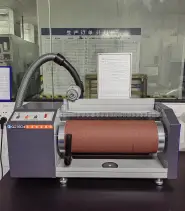
Abrasive Testing Machine
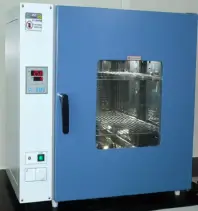
Burn-in Chamber
