
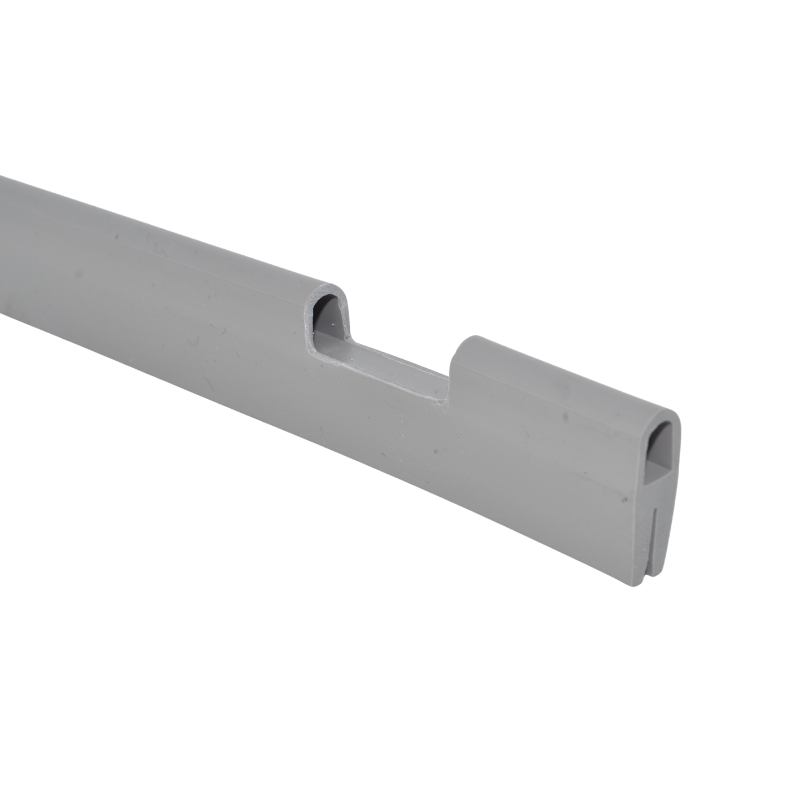
EPDM Rubber Frame Seal
Engineered for continuous-perimeter sealing across irregular and stepped frames, this extruded EPDM rubber frame seal maintains uniform compression force whether the profile runs a straight run, a tight corner radius, or a tolerance-stacked step. Available in solid, hollow, and closed-cell foamed configurations, it covers dishwasher door gaskets, washing machine door-adjacent seals, AC unit frame seals,…
Specifications
|
Product Type: |
Extruded sealing profile (frame gasket / enclosure seal)
|
|---|---|
|
Base Polymer: |
Ethylene Propylene Diene Monomer (EPDM)
|
|
Structure: |
Solid / Hollow / Closed-Cell Foamed — per customer spec
|
|
Color: |
Black (standard); gray, white, custom colors available
|
|
Surface Finish: |
Smooth / matte; talc-dusted or flocked on request
|
|
Standards & Compliance: |
|
|
Hardness: |
Solid: 50 ± 5 Shore A to 65 ± 5 Shore A; Foamed: 25–40 Shore A (density 0.35–0.65 g/cm³)
|
|
Tensile Strength: |
Solid: ≥ 8 MPa; Foamed: ≥ 1.5 MPa
|
|
Elongation at Break: |
Solid: ≥ 300%; Foamed: ≥ 200%
|
|
Tear Strength: |
Solid: ≥ 18 kN/m; Foamed: ≥ 5 kN/m
|
|
Recommended Service Temperature: |
-45°C to +150°C (solid); -40°C to +120°C (foamed)
|
|
Hot Air Aging: |
100°C × 72h: hardness change ≤ ±8 Shore A; tensile retention ≥ 80%
|
|
Low‑Temperature Brittleness: |
≤ -45°C (solid)
|
|
Typical Applications: |
Dishwasher frame gaskets, washing machine door-adjacent seals, AC unit frame seals, access panel profiles, refrigerator cabinet perimeter seals
|
Description:
EPDM’s distinguishing feature is a saturated polyethylene-propylene main chain — crosslinking occurs only at the diene termonomer sites, leaving the backbone chemically inert to ozone, UV, and oxidative attack. That matters for appliance engineers more than any single test number. A dishwasher frame gasket cycles between 75–85°C steam and ambient cooling hundreds of times per year; a washing machine door seal flexes and compresses with every load. EPDM sustains elasticity down to -45°C and retains its modulus up to 150°C, which means the compression force it delivers on day one is still within spec after years of thermal cycling. Low compression set — the tendency of a gasket to take a permanent “flat” under sustained load — is governed by the vulcanization system and is tuned per compound to ensure reliable rebound across the service life of the appliance.
Typical Industry Applications:
Proven performance across demanding manufacturing environments.
| Industry | Typical Use Cases |
|---|---|
| Home Appliances | Dishwasher door frame gaskets, washing machine door-adjacent seals, refrigerator cabinet perimeter seals, oven door closure profiles, dryer access panel strips |
| Automotive & Motorcycle | Door frame seals, trunk lid perimeter gaskets, body panel access covers, engine bay weatherstripping |
| Construction & Architecture | Window and curtain wall frame seals, HVAC panel closures, access door perimeter gaskets, rooftop equipment enclosures |
| Electronics & Industrial Machinery | Control cabinet door seals, IP-rated enclosure gaskets, access panel profiles, switchgear housing seals |
| Lighting & LED | Weatherproof luminaire housing seals, outdoor fixture frame gaskets, junction box perimeter strips |
Chemical Resistance Table:
| Chemical / Medium | Resistance | Notes |
|---|---|---|
| Water (ambient and up to 100°C) | ✅ Excellent | Core EPDM strength; suitable for steam-cycle environments |
| Steam (up to 120°C, intermittent) | ✅ Excellent | Minimal hydrolytic degradation |
| Dishwasher detergent solutions | ✅ Excellent | Alkaline and enzyme-based formulations |
| Dilute sulfuric acid (≤ 10%) | ✅ Excellent | Detergent-grade acid exposure |
| Dilute sodium hydroxide (≤ 10%) | ✅ Excellent | Standard alkaline cleaning agents |
| Ozone / UV weathering | ✅ Excellent | Saturated backbone; no ozone cracking under outdoor exposure |
| Silicone oils and greases | ✅ Excellent | Compatible with common appliance assembly lubricants |
| Phosphoric acid (dilute) | ✓ Good | Concentration-dependent; verify above 20% |
| Ethanol (≤ 70%) | ✓ Good | Common sanitizer; minor swell at elevated concentrations |
| Acetone / MEK | ✓ Good | Short-term exposure acceptable; avoid prolonged immersion |
| Refrigerants (R-134a, R-410A, static contact) | ⚠ Limited | Acceptable in static seal applications; verify dynamic contact conditions |
| Mineral oils and greases | ⚠ Limited | Moderate swelling; specify NBR for continuous oil contact |
| Petroleum fuels (gasoline, diesel) | ✗ Not recommended | Significant swell; select NBR or FKM |
| Aromatic solvents (toluene, xylene) | ✗ Not recommended | High swelling; incompatible |
| Chlorinated solvents (DCM, TCE) | ✗ Not recommended | Severe attack; incompatible |
In-House Quality Assurance & Testing:
At Micune Rubber, batch-to-batch consistency is guaranteed through our ISO-9001 certified Quality Management System. Every rubber compound and custom extrusion undergoes rigorous evaluation in our dedicated testing laboratory before shipment. We utilise industry-standard baseline testing, including Mooney Viscometers to measure compound viscosity and Torque Rheometers to verify exact vulcanisation characteristics. This ensures every material formulation strictly adheres to your required specifications and processing parameters.
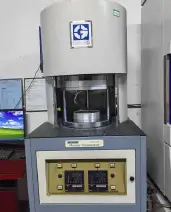
Mooney Viscometer
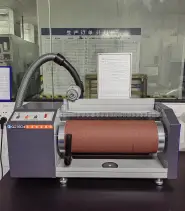
Abrasive Testing Machine
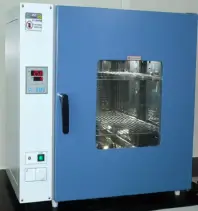
Burn-in Chamber
